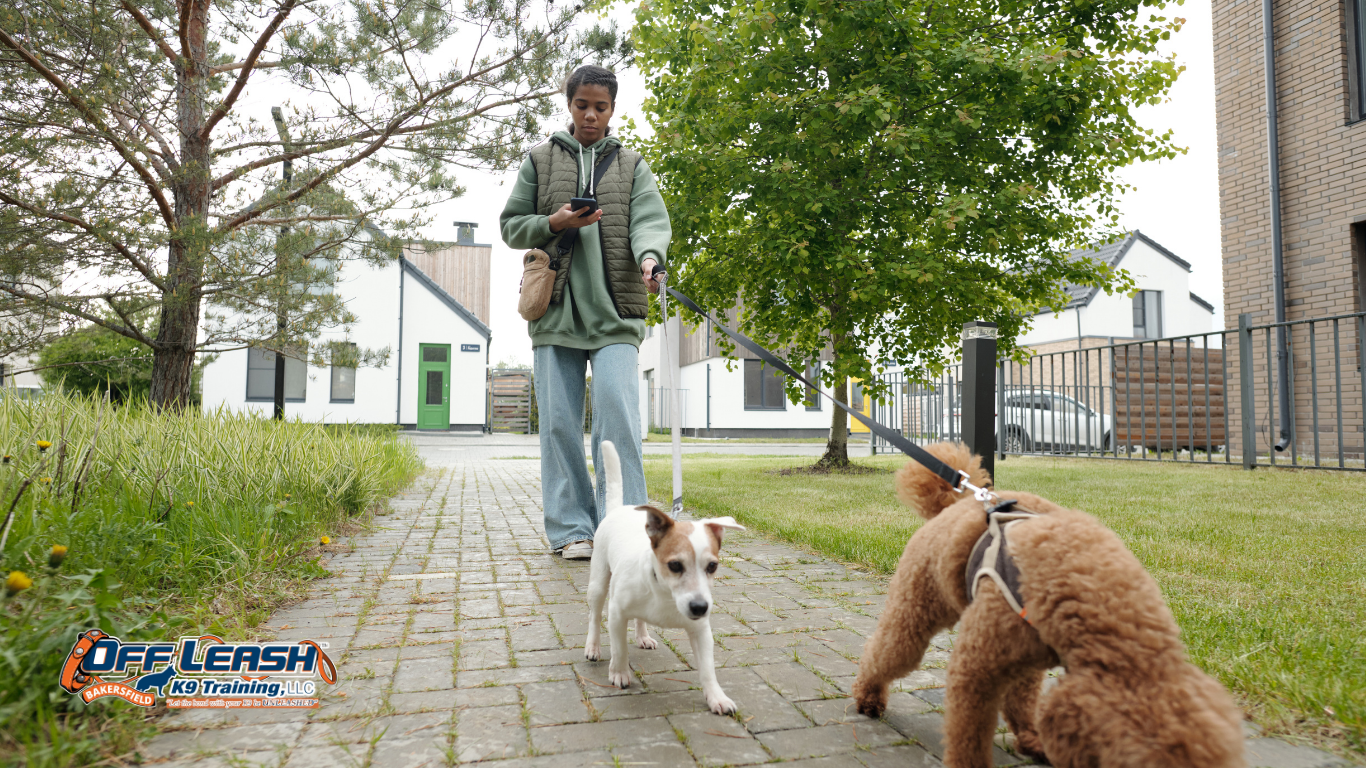
Why Dogs Struggle to Walk Beside Their Owners: Building Better Leash Manners
A peaceful walk sounds simple: your dog walks beside you, the leash remains relaxed, and both of you enjoy the time outdoors.
For many owners, however, walks look very different.
Their dog may:
- Pull ahead
- Zigzag across the sidewalk
- Stop suddenly
- Pull toward smells
- Rush toward other dogs
- Chase birds
- Lag behind
- Become distracted by people
- Constantly change direction
- Ignore familiar commands
If your dog struggles to walk beside their owners, it does not necessarily mean they are stubborn or refusing to cooperate. Dogs experience the outdoor world very differently from humans, and walking beside a person requires learned skills.
Outside, dogs encounter an enormous amount of information.
Every smell, sound, movement, and animal can compete for their attention.
A dog may be thinking:
“What’s that smell?”
“Who is that?”
“Can I go over there?”
“What animal just moved?”
“Why did that sound happen?”
Without training, investigating these things is often more rewarding than staying beside their owner.
Leash training teaches dogs how to balance natural curiosity with cooperation.
The goal is not necessarily to make a dog walk in a rigid heel for an entire outing. Instead, most family dogs benefit from learning reliable loose leash walking, where they can explore while maintaining a comfortable connection with their handler.
For Bakersfield dog owners, these skills can make neighborhood walks, park visits, outdoor activities, and everyday errands considerably easier.
Key Takeaways
- Dogs do not automatically know how to walk beside people.
- Pulling is often reinforced by access to interesting distractions.
- Smells and environmental stimulation can compete strongly for attention.
- Fear and excitement can both affect leash behavior.
- Puppies and adolescent dogs often need additional impulse-control practice.
- Loose leash walking is different from a formal heel.
- Positive reinforcement helps dogs learn where their attention should go.
- Short, consistent training sessions produce better habits.
- Dogs should still receive appropriate opportunities to sniff and explore.
- Professional leash training can help create calmer, safer, and more enjoyable walks.
What Does “Struggle to Walk Beside Their Owners” Mean?
When dogs struggle to walk beside their owners, they have difficulty maintaining a comfortable, cooperative walking position while staying connected to their handler. Instead of moving with the person, they may pull ahead, lag behind, zigzag, stop frequently, or become focused on everything happening around them.
This does not necessarily mean a dog is stubborn.
Walking beside a person is a learned behavior. Dogs naturally want to investigate their surroundings, follow interesting scents, approach other animals, and respond to movement. Without training, those natural behaviors can compete with leash manners.
A dog struggling to stay close may:
- Pull toward interesting smells
- Walk several steps ahead
- Constantly change directions
- Stop to investigate objects
- Pull toward other dogs
- Chase birds or squirrels
- Become distracted by pedestrians
- Ignore familiar cues outdoors
- Become tense or frustrated on the leash
The goal of leash training is not necessarily to make a dog walk perfectly at the owner’s side every second.
Instead, most family dogs benefit from learning loose leash walking. This allows them to explore appropriately while maintaining a relaxed connection with their owner.
Why Dogs Have Difficulty Staying Close
Dogs have many reasons for wanting to move away from their owner’s side.
Understanding the motivation makes training much more effective.
The Environment Is Interesting
Outdoor environments contain an enormous amount of information.
Dogs can investigate:
- Scents
- Sounds
- Wildlife
- People
- Other dogs
- Vehicles
- Grass
- Trees
- New objects
Remaining beside an owner may be less rewarding than investigating these distractions.
Training teaches dogs that staying connected with their handler also produces positive outcomes.
Dogs Naturally Move Differently Than People
Humans tend to walk at a relatively steady pace.
Dogs frequently change speed.
They may:
- Speed up
- Slow down
- Stop
- Circle
- Sniff
- Change direction
Without guidance, the dog simply follows whatever currently interests them.
Previous Pulling Has Been Rewarded
Pulling often works.
A dog pulls toward a tree.
The owner follows.
The dog reaches the tree.
From the dog’s perspective:
Pulling produced access.
Repeated experiences strengthen the behavior.
Leash training changes this pattern by rewarding calm walking and appropriate engagement.
Puppies Have Limited Impulse Control
Puppies are naturally curious and easily distracted.
A young puppy may understand a walking cue indoors but struggle to maintain it outside.
This is normal.
Training should begin with simple environments and gradually increase distractions.
Exploration vs. Leash Manners
A common misconception is that good leash training requires dogs to ignore everything around them.
It does not.
Dogs need opportunities to explore.
Sniffing, investigating, and observing their surroundings provide important mental stimulation.
The goal is balance.
Structured Exploration
A healthy walk can include both:
Polite walking → exploration → polite walking → exploration
For example, the owner may walk calmly for several minutes before allowing the dog to investigate a grassy area.
This teaches the dog that exploration is available without pulling.
Why Sniffing Matters
Sniffing allows dogs to gather information about their environment.
It can provide:
- Mental stimulation
- Environmental information
- Natural enrichment
- Opportunities to make choices
Preventing all sniffing can make walks unnecessarily restrictive.
Instead, owners can teach dogs when it is appropriate to walk and when it is appropriate to investigate.
Loose Leash Walking vs. Heel
A formal heel requires a dog to remain in a specific position.
Loose leash walking is more flexible.
The dog may move slightly ahead or to the side as long as the leash remains relaxed and the dog remains responsive.
For everyday family walks, loose leash skills are usually more practical than requiring a competition-style heel.
The Role of Smells, Movement, and Distractions
Dogs experience the world through their senses.
During a walk, nearly everything can compete for their attention.
Smells
A single scent can completely change a dog’s direction.
Interesting smells may come from:
- Other dogs
- Wildlife
- Food
- Grass
- Trees
- Trash
- Other animals
Instead of fighting the dog’s natural interest, training can teach them to investigate without dragging their owner.
Movement
Dogs are naturally attentive to movement.
Common triggers include:
- Joggers
- Cyclists
- Skateboards
- Birds
- Squirrels
- Passing vehicles
- Children running
Fast movement can increase excitement and make staying close more difficult.
Other Dogs
Another dog approaching can produce several different reactions.
A dog may want to:
- Say hello
- Play
- Avoid the other dog
- Bark
- Create distance
Understanding the dog’s emotional response is essential.
Not every dog pulling toward another dog wants to play, and not every dog pulling away is being stubborn.
People
Pedestrians can also become distractions.
Some dogs pull toward people because they are social and excited.
Others may become nervous.
Training should account for the dog’s emotional state rather than assuming every pulling behavior has the same cause.
Excitement, Fear, and Leash Behavior
Leash difficulties are not always caused by excessive energy.
Emotion plays a major role.
Excitement
Excited dogs may:
- Pull forward
- Jump
- Whine
- Bark
- Move rapidly
- Ignore cues
The environment is so stimulating that the dog struggles to maintain focus.
Impulse-control training can help create a pause between excitement and action.
Fear
Fear can produce completely different leash behavior.
A nervous dog may:
- Pull away
- Freeze
- Hide behind the owner
- Bark
- Growl
- Try to escape
For these dogs, forcing them closer to the trigger may increase stress.
Building confidence and maintaining an appropriate distance are more productive strategies.
Frustration
Some dogs become frustrated when they can see something they cannot reach.
For example:
A dog sees another dog.
The leash prevents access.
The dog begins pulling and barking.
This is sometimes called leash frustration.
Teaching the dog to redirect attention toward the handler provides a healthier alternative.
Body Language During Difficult Walks
A dog’s body language often reveals why walking is becoming difficult.
Recognizing these signals allows owners to respond before the behavior escalates.
Signs of Excitement
Look for:
- Forward body position
- Rapid tail movement
- Bouncy movement
- Increased pulling
- Whining
- Fast breathing
- Intense attention toward a distraction
Signs of Fear
Fear may appear as:
- Tail tucked
- Ears pinned back
- Lowered body
- Lip licking
- Avoidance
- Freezing
- Trembling
Signs of Escalating Arousal
A dog approaching their threshold may show:
- Stiff posture
- Hard staring
- Rapid scanning
- Increased vocalization
- Sudden pulling
- Reduced response to cues
At this stage, increasing distance and reducing stimulation can help the dog regain control.
Emotional Regulation and Walking
Good leash manners require more than mechanical obedience.
Dogs need to regulate their emotions while navigating a stimulating environment.
A dog with healthy emotional regulation can notice a distraction without immediately reacting.
For example:
See dog → look → check in → continue walking.
Instead of:
See dog → pull → bark → lose focus.
Teaching Recovery
Dogs should learn that excitement does not have to continue indefinitely.
After encountering a distraction, give the dog an opportunity to:
- Slow down
- Sniff
- Check in
- Walk calmly
- Return to a familiar cue
Recovery is an important part of leash training.
Reward Calm Choices
Whenever your dog voluntarily returns attention to you, reward the behavior.
Useful moments include when the dog:
- Looks at you
- Loosens the leash
- Walks beside you
- Ignores a distraction
- Turns away from another dog
- Resumes walking after stopping
These small decisions build reliable walking habits.
Build Skills Gradually
A dog cannot be expected to perform perfectly in the most distracting environment immediately.
Start with:
- Quiet areas
- Mild distractions
- Familiar walking routes
- Gradually busier environments
This progression allows the dog to succeed repeatedly.
Over time, walking beside an owner becomes less of a difficult command and more of a familiar habit. The dog learns that staying connected does not mean giving up exploration. Instead, calm walking, appropriate sniffing, attention to the handler, and opportunities to investigate can all become part of the same rewarding routine.
Common Owner Mistakes
When dogs struggle to walk beside their owners, many owners unintentionally reinforce the exact behaviors they want to change. Leash training becomes much easier when everyone understands what the dog is learning from each walk.
Allowing Pulling to Work
If a dog pulls toward a smell and eventually reaches it, pulling has been rewarded.
The dog learns:
Pull → move forward → reach interesting thing.
Instead, wait for a relaxed leash before allowing access whenever practical.
This teaches:
Loose leash → access to something rewarding.
Pulling Back on the Leash Constantly
Some owners respond to pulling by continuously pulling in the opposite direction.
This can create a frustrating cycle where both dog and owner are putting tension on the leash.
Instead, teach the dog what behavior earns forward movement.
Reward:
- Loose leash
- Attention
- Calm walking
- Voluntary check-ins
Expecting Perfect Focus
Dogs do not need to stare at their owners throughout an entire walk.
Constant attention is unrealistic and can make walks unnecessarily restrictive.
Allow appropriate sniffing and exploration while teaching the dog to reconnect when needed.
Increasing Distractions Too Quickly
A dog that walks beautifully on a quiet street may struggle in a busy park.
That does not mean training failed.
The environment simply became more difficult.
Progress gradually from easier locations to more distracting ones.
Becoming Frustrated
Owners may become frustrated when a dog repeatedly pulls.
Unfortunately, frustration can increase tension for both ends of the leash.
Calm, consistent responses make learning easier.
Teaching Dogs to Walk Beside Their Owners
The goal is to create a dog that understands how to remain connected while enjoying the environment.
Start in a Low-Distraction Area
Begin somewhere your dog can succeed.
This might be:
- A quiet driveway
- A backyard
- A calm sidewalk
- An empty outdoor area
Reward the dog for walking near you with a relaxed leash.
Teach Voluntary Check-Ins
Whenever your dog looks toward you without being asked, reward them.
This creates an important habit:
“Checking in with my owner is worthwhile.”
Over time, those check-ins can happen naturally during walks.
Reward the Position You Want
If you want your dog walking beside you, reward that position.
Use treats, praise, or access to something your dog enjoys.
The reward should occur while the dog is demonstrating the desired behavior.
Use Changes in Direction
Gentle changes in direction can encourage dogs to pay attention to their handler.
Rather than dragging the dog into position, move calmly and reward the dog when they choose to follow.
This creates cooperation rather than conflict.
Use Sniffing as a Reward
Sniffing can become part of the training process.
For example:
Walk calmly → reward → “Go sniff.”
This teaches the dog that polite walking does not eliminate their opportunity to explore.
Practice Short Sessions
Long walks are not always the best training sessions.
Begin with manageable periods of successful walking.
As your dog’s skills improve, gradually increase:
- Distance
- Duration
- Distractions
- Environmental complexity
Small successes build reliable habits.
Struggle to Walk Beside Their Owners in Bakersfield
For Bakersfield dog owners, leash skills can make neighborhood walks and everyday outings much easier.
Dogs may encounter:
- Pedestrians
- Other dogs
- Bicycles
- Vehicles
- Wildlife
- Children
- Outdoor activity
- New smells
- Busy intersections
- Community parks
Each situation provides an opportunity to practice calm walking and engagement.
Professional leash training can help Bakersfield families address:
- Pulling
- Zigzagging
- Lunging
- Leash frustration
- Distraction problems
- Poor engagement
- Fear-based walking
- Difficulty settling after exciting encounters
Training in realistic environments also helps dogs understand that their skills apply outside the home.
A dog that learns to walk calmly on a quiet street can gradually practice in more stimulating locations as confidence and reliability improve.
Long-Term Benefits of Better Leash Skills
Teaching a dog to walk beside their owner provides benefits that extend far beyond having a more pleasant walk.
Improved Safety
Better leash skills reduce the likelihood of dogs suddenly pulling toward:
- Traffic
- Wildlife
- Other animals
- People
- Dangerous objects
Reliable walking habits provide owners with greater control when unexpected situations occur.
Better Communication
Leash training creates a stronger communication system between dog and owner.
The dog learns to recognize:
- Direction changes
- Verbal cues
- Body language
- Reward opportunities
- Expectations during walks
Greater Confidence
Dogs that understand what is expected of them often become more confident in unfamiliar environments.
Instead of reacting to everything, they can rely on familiar skills.
Improved Impulse Control
Walking provides constant opportunities to practice:
- Waiting
- Ignoring distractions
- Checking in
- Changing direction
- Resuming movement
These skills transfer into other areas of life.
More Enjoyable Exercise
When dogs are not constantly pulling, walks become more pleasant for everyone.
Frequently Asked Questions
1. Why does my dog refuse to walk beside me?
Dogs may struggle because of distractions, excitement, fear, curiosity, lack of leash training, or a history of being rewarded for pulling. Identifying the reason helps determine the right training strategy.
2. Does walking beside me mean my dog has to heel?
No. A formal heel requires a very specific position. Most everyday walks only require reliable loose leash walking and a comfortable connection with the owner.
3. Should my dog be allowed to sniff during walks?
Yes. Sniffing provides important mental stimulation. Teaching your dog when to walk and when to sniff creates a healthier balance.
4. Why does my dog walk well at home but pull outside?
Outdoor environments contain significantly more distractions. Your dog may understand the behavior but lack sufficient practice around real-world stimulation.
5. Can puppies learn to walk beside their owners?
Absolutely. Puppies can begin learning leash skills through short, positive sessions. Their training should account for their developing attention span and impulse control.
6. Can an adult dog learn better leash manners?
Yes. Adult dogs can develop new habits through consistent positive reinforcement. Dogs with years of pulling may need additional time and practice, but age does not prevent learning.
7. Why does my dog pull toward other dogs?
The motivation can vary. Some dogs are excited and want to interact, while others are frustrated, fearful, or overwhelmed. Body language can help identify the underlying emotion.
8. Should I use treats during leash training?
Treats can be an effective reward, particularly when teaching a new behavior. Over time, other rewards such as praise, sniffing opportunities, and forward movement can also become useful.
9. How long does it take to teach loose leash walking?
There is no universal timeline. Puppies, adult dogs, and dogs with established pulling habits progress at different rates. Consistent short sessions generally produce better results than occasional intensive training.
10. When should I consider professional leash training?
Professional guidance can be especially helpful when pulling is severe, the dog lunges or reacts to distractions, walking has become stressful, or previous training attempts have not produced reliable results.
Comprehensive Conclusion
When dogs struggle to walk beside their owners, the problem is rarely as simple as stubbornness. Dogs experience the outdoor world through powerful sensory information, and every walk presents opportunities to investigate smells, movement, animals, people, and unfamiliar sounds. Without appropriate training, those distractions can easily become more rewarding than staying connected with their handler.
The solution is not to eliminate a dog’s natural curiosity. Healthy walks should include opportunities to sniff, explore, and observe the environment. Instead, dogs can learn how to balance those natural behaviors with polite leash manners. Loose leash walking teaches dogs that they can enjoy their surroundings without dragging their owners from one distraction to another.
Positive reinforcement makes this process more effective by rewarding the behaviors owners want to see. Voluntary check-ins, relaxed leash tension, calm walking, and appropriate responses to distractions can all be reinforced. With enough repetition, these small decisions become increasingly automatic.
Emotional regulation is equally important. A dog that becomes overwhelmed by another dog, a cyclist, wildlife, or a loud noise may temporarily lose the ability to respond to familiar cues. Teaching the dog to recover, reconnect with their owner, and continue walking calmly builds skills that extend far beyond leash manners.
For Bakersfield dog owners, reliable leash skills can transform everyday outings. Neighborhood walks become easier, public environments become more manageable, and owners can enjoy spending time outdoors without constantly fighting against the leash. Dogs also gain confidence as they learn that their owners provide clear guidance during unfamiliar or distracting situations.
Ultimately, the goal is not a dog that never looks away from their owner. It is a dog that can explore the world while maintaining a reliable connection with the person holding the leash. With patience, consistency, positive reinforcement, and gradual exposure to distractions, dogs can learn to walk calmly, make better choices, and enjoy the freedom of a well-structured walk beside their owners.
Website Contact Form
"*" indicates required fields