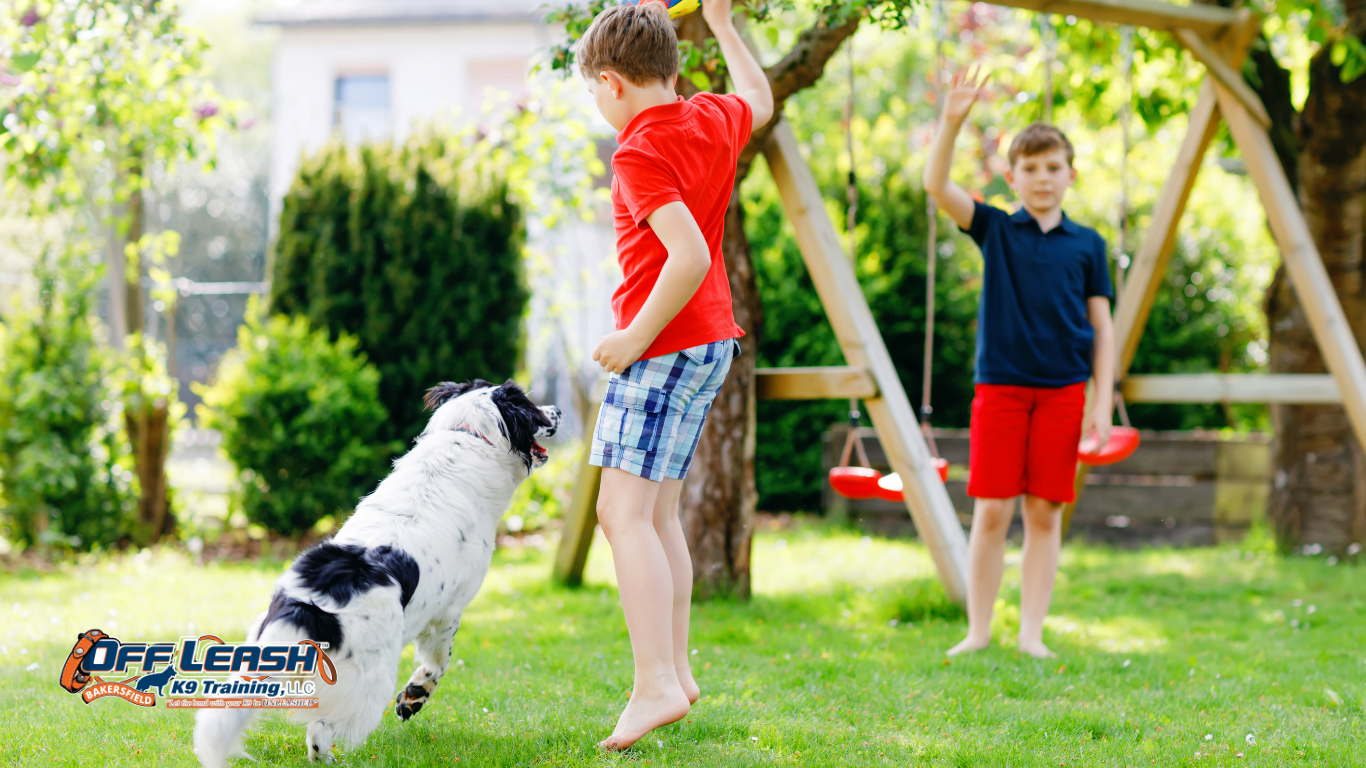
Why Puppies Jump on Children: Understanding and Stopping Jumping Behavior
Many new puppy owners discover that their puppy behaves politely around adults but becomes wildly excited the moment children enter the room. If your puppy jumps on children, you’re seeing one of the most common puppy behaviors.
Children naturally attract puppies because they:
- Move quickly
- Laugh loudly
- Run unpredictably
- Wave their arms
- Play energetic games
- Get down closer to the puppy’s level
To a young puppy, all of these behaviors look like invitations to play.
Puppies that jump on children may also:
- Bounce repeatedly
- Paw at clothing
- Nip gently during excitement
- Lick faces
- Chase running children
- Bark during play
- Grab sleeves or pant legs
- Spin in circles
- Ignore verbal cues
- Continue jumping after being pushed away
Fortunately, this behavior is usually not a sign of aggression. Instead, it reflects a puppy that has not yet learned impulse control or appropriate greeting manners.
Several factors contribute to jumping on children, including:
- Excitement
- Natural play instincts
- Limited self-control
- Reinforced jumping
- Curiosity
- Social interaction
- Teething
- Excess energy
The good news is that puppies are excellent learners. By rewarding calm greetings, teaching alternative behaviors such as sitting, and helping children interact consistently, owners can replace jumping with polite, confident behavior.
For Bakersfield families, teaching puppies how to behave appropriately around children creates a safer, calmer home while helping puppies develop into well-mannered adult dogs.
Key Takeaways
- Jumping on children is a very common puppy behavior.
- Most jumping is motivated by excitement, not aggression.
- Children naturally trigger playful behavior.
- Puppies need impulse control training.
- Calm greetings should be rewarded consistently.
- Redirection works better than punishment.
- Consistency among family members is essential.
- Children should learn appropriate interactions, too.
- Early training prevents jumping from becoming a lifelong habit.
- Most puppies learn polite greetings through positive reinforcement and consistent practice.
What Does “Jump on Children” Mean?
When puppies jump on children, they excitedly leap toward kids by placing their front paws on them, bouncing around them, or trying to initiate play. While this behavior may seem cute when puppies are small, it can quickly become overwhelming or unsafe as they grow.
In most cases, jumping is not a sign of aggression.
Instead, it is a natural expression of excitement, curiosity, and social interaction.
Children naturally capture a puppy’s attention because they often:
- Run
- Laugh
- Wave their arms
- Make high-pitched sounds
- Play energetic games
- Move unpredictably
To a puppy, these behaviors often appear to be invitations to join the fun.
Puppies that jump on children may also:
- Paw at clothing
- Lick faces
- Nip gently during excitement
- Chase running kids
- Grab pant legs
- Bark while playing
- Spin in circles
- Ignore commands
- Continue bouncing after being redirected
- Experience bursts of playful energy
These behaviors usually reflect immature impulse control rather than intentional misbehavior.
Understanding why puppies jump helps owners teach appropriate greetings before the habit becomes well established.
Why Movement Is So Exciting
Movement naturally activates a puppy’s attention.
Every running child creates:
- Motion
- Sound
- Changing direction
- Opportunities for interaction
Young puppies instinctively want to participate.
Without guidance, they simply react to excitement.
Why Puppies Are Drawn to Children
Children behave differently than adults.
Their energy level naturally attracts puppies.
Children Move Like Playmates
Puppies spend much of their early life chasing and wrestling with littermates.
Running children often resemble that style of play.
Fast movement encourages puppies to:
- Chase
- Jump
- Follow
- Bounce
- Mouth gently
- Bark excitedly
The puppy is responding to movement rather than intentionally misbehaving.
High-Pitched Voices Increase Excitement
Dogs are especially sensitive to higher-pitched sounds.
Children often:
- Laugh loudly
- Squeal
- Giggle
- Talk excitedly
These sounds naturally increase emotional arousal.
Unpredictable Behavior Keeps Puppies Interested
Adults usually move in calm, predictable ways.
Children often:
- Change direction suddenly
- Sit on the floor
- Stand quickly
- Run unexpectedly
- Drop toys
- Wave objects
These constantly changing movements make children especially interesting to curious puppies.
Social Curiosity
Puppies are naturally social animals.
They investigate people through:
- Sniffing
- Following
- Licking
- Pawing
- Jumping
Children often receive extra attention simply because they move more than adults.
Play Behavior vs. Aggression
Many owners worry that jumping means their puppy is becoming aggressive.
Fortunately, this is rarely true.
Most puppies jump because they are excited to interact.
Signs of Playful Behavior
Playful puppies usually display:
- Loose body posture
- Relaxed muscles
- Wagging tails
- Soft eyes
- Play bows
- Bouncy movement
- Open mouths
Their goal is social interaction.
Signs That Require More Attention
Although uncommon, owners should monitor behavior that becomes:
- Extremely intense
- Difficult to interrupt
- Accompanied by stiff posture
- Escalating into repeated hard biting
- Triggered by frustration rather than excitement
These situations may benefit from early professional guidance.
Why Puppies Use Their Bodies During Play
Dogs communicate physically.
Jumping, pawing, chasing, and bouncing are all normal parts of canine play.
The goal is not eliminating these instincts.
Instead, owners teach puppies where and when those behaviors are appropriate.
The Role of Excitement and Impulse Control
Young puppies have very limited self-control.
When something exciting happens, they react immediately.
Children create multiple exciting events simultaneously:
- Movement
- Noise
- Attention
- Play opportunities
The puppy’s brain often struggles to slow down.
Emotional Arousal
Excitement increases:
- Heart rate
- Energy
- Movement
- Play behavior
Without training, puppies simply follow their instincts.
Learning Self-Control
Impulse control develops gradually through:
- Consistent routines
- Positive reinforcement
- Practice
- Maturity
Helpful exercises include:
- Sit
- Wait
- Leave It
- Place
- Calm greetings
Each successful repetition strengthens the puppy’s ability to pause before reacting.
Body Language Before Jumping
Puppies almost always display body language before they leap toward a child.
Recognizing these early signs allows owners to redirect excitement before jumping begins.
Common signals include:
- Intense staring
- Tail wagging rapidly
- Wiggles
- Weight shifting forward
- Small playful hops
- Ears forward
- Mouth opening
- Quick head movements
- Increased breathing
- Sudden bursts of energy
These signs often appear only seconds before the puppy jumps.
The Zoomies Connection
Jumping frequently occurs during periods of high excitement, including:
- Evening zoomies
- Family playtime
- Children running indoors
- Backyard games
- Guests arriving
Recognizing these predictable situations allows owners to prepare before excitement escalates.
Emotional Regulation Around Kids
Emotional regulation is a puppy’s ability to remain calm even when exciting things happen nearby.
Young puppies are still developing this important life skill.
Puppies with stronger emotional regulation can:
- Watch children play without jumping.
- Sit politely for greetings.
- Respond to their name.
- Ignore running feet.
- Recover quickly after excitement.
- Settle when play ends.
These abilities improve through repeated practice.
Helpful training activities include:
- Place training
- Rewarding calm behavior
- Short obedience sessions
- Controlled greetings
- Impulse-control games
- Structured play breaks
- Scheduled naps
Rather than expecting puppies to naturally outgrow jumping, owners can use daily interactions with children as opportunities to teach better choices. Every calm greeting, every successful sit before saying hello, and every rewarded moment of self-control helps puppies build the emotional regulation they need to interact safely and politely. Over time, these repeated positive experiences replace impulsive jumping with calm, confident greetings that benefit both the puppy and the entire family.
Common Owner Mistakes
When puppies jump on children, owners often respond instinctively without realizing they may be reinforcing the behavior. Since most jumping is driven by excitement, the way adults and children react plays a major role in whether the habit improves or becomes stronger.
Understanding these common mistakes helps puppies develop better greeting manners while keeping interactions safe and enjoyable.
Allowing Jumping Because the Puppy Is Small
Many owners tolerate jumping when their puppy is tiny.
Comments like:
- “They’re just excited.”
- “They’re only a puppy.”
- “It’s cute.”
are common.
However, puppies quickly develop habits.
A behavior that seems harmless at ten pounds can become unsafe when the dog reaches fifty pounds or more.
Teaching polite greetings early prevents future problems.
Encouraging Excitement
- Run
- Laugh
- Wave toys
- Squeal
- Chase puppies
Although fun, these activities often increase jumping.
Instead, teach children to remain calm while greeting the puppy.
Calm interactions produce calmer behavior.
Pushing the Puppy Away
When a puppy jumps, many people instinctively push them off.
Unfortunately, some puppies interpret this as continued play.
Hands touching the puppy may actually reward the interaction.
Instead:
- Stand still.
- Remove attention.
- Ask for an alternative behavior such as Sit.
- Reward calm greetings.
Using Inconsistent Rules
Sometimes the puppy is allowed to jump.
Other times they are corrected.
This inconsistency slows learning.
Everyone in the household should follow the same greeting routine.
Skipping Training Around Real Distractions
Many puppies sit perfectly indoors.
Then they forget everything when children arrive.
Practice around gradually increasing distractions helps puppies succeed in real-life situations.
Teaching Puppies Calm Greetings
The goal is not to eliminate excitement.
The goal is teaching puppies how to express excitement appropriately.
Teach Sit Before Greetings
Before allowing the puppy to greet a child:
Ask for:
- Sit
- Eye contact
- Calm behavior
Once the puppy remains seated, the greeting can begin.
Over time, puppies learn:
“Sitting makes people come closer.”
Reward Four Paws on the Floor
Whenever your puppy keeps all four paws on the ground:
- Praise calmly.
- Offer a treat.
- Allow gentle attention.
Dogs repeat behaviors that consistently earn rewards.
Practice With Calm Children
Begin with children who can follow simple instructions.
Teach them to:
- Stand still.
- Avoid squealing.
- Keep hands low.
- Wait for the puppy to sit.
- Pet gently after calm behavior.
Controlled practice creates successful learning opportunities.
Redirect Excitement
If the puppy becomes overly excited:
Redirect toward:
- A toy
- A chew
- Place
- A brief training exercise
Redirection prevents repeated jumping.
Build Impulse Control Daily
Helpful exercises include:
- Wait
- Leave It
- Stay
- Place
- Loose leash walking
These skills improve self-control in many different situations—not just greetings.
Jump on Children in Bakersfield
For Bakersfield families, teaching polite greetings helps puppies safely enjoy everyday life.
Children and puppies commonly interact during:
- Neighborhood walks
- Family gatherings
- School pickups
- Parks
- Community events
- Backyard play
- Pet-friendly businesses
- Visits with friends and relatives
Professional puppy training helps Bakersfield families develop:
- Calm greetings
- Bite inhibition
- Impulse control
- Emotional regulation
- Family safety
- Appropriate play skills
Early training helps puppies become confident, respectful companions around people of all ages.
Long-Term Benefits of Early Training
Teaching polite greetings during puppyhood creates lifelong advantages.
Long-term benefits include:
- Better impulse control
- Reduced jumping
- Improved obedience
- Safer interactions with children
- Greater confidence
- Better focus
- Easier public outings
- Stronger family relationships
- Improved emotional regulation
- Better overall household manners
The habits established during puppyhood often remain throughout adulthood.
Frequently Asked Questions
1. Why does my puppy jump on children but not adults?
Children often move faster, make louder noises, and behave more playfully than adults, making them naturally more exciting to puppies.
2. Is jumping a sign of aggression?
Usually not. Most puppies jump because they are excited and want to interact, not because they are being aggressive.
3. Should children push the puppy away?
No. Pushing may accidentally encourage more jumping. Instead, children should stand still while an adult redirects the puppy and rewards calm behavior.
4. Should I teach Sit before greetings?
Yes. Teaching puppies to sit before receiving attention is one of the most effective ways to replace jumping with polite greetings.
5. Why does my puppy jump more when children run?
Running activates a puppy’s chase and play instincts. Fast movement naturally increases excitement and makes jumping more likely.
6. Can professional puppy training help?
Absolutely. Professional trainers teach impulse control, appropriate greeting skills, and emotional regulation while helping families practice safe interactions with children.
7. At what age should I begin training?
Immediately. Puppies begin learning household rules from the day they arrive home. Early consistency helps prevent unwanted habits from becoming established.
8. Will my puppy outgrow jumping?
Some puppies become calmer with maturity, but without training many continue jumping into adulthood. Teaching polite greetings early produces more reliable results.
9. How can children help with training?
Children can participate by remaining calm, avoiding running during greeting practice, waiting for the puppy to sit, and rewarding gentle behavior under adult supervision.
10. What if my puppy also nips while jumping?
Jumping and gentle nipping often occur together during excitement. Redirect the puppy to an appropriate toy, pause the interaction if they become overly excited, and continue practicing impulse-control exercises. If biting becomes intense or difficult to interrupt, consult a qualified professional trainer.
Comprehensive Conclusion
Why Puppies Jump on Children is rooted in normal puppy development, social curiosity, and excitement rather than bad behavior. Children naturally attract puppies because they move quickly, laugh loudly, and create energetic interactions that resemble play with littermates. Without guidance, puppies simply respond to that excitement by jumping, bouncing, and trying to engage.
The encouraging news is that puppies are highly capable of learning polite greeting skills. By rewarding four paws on the floor, teaching a reliable Sit before greetings, practicing impulse-control exercises, and helping children interact calmly and consistently, owners can replace jumping with safe, respectful behavior. Every successful greeting strengthens the puppy’s confidence and self-control while making family interactions more enjoyable.
For Bakersfield families, early training provides benefits that extend far beyond preventing jumping. Puppies that learn appropriate greeting manners are often easier to manage during neighborhood walks, visits with friends, trips to parks, veterinary appointments, and community events. These experiences help puppies develop into well-mannered adult dogs that can confidently interact with people of all ages.
Ultimately, jumping is simply a stage in a puppy’s learning process. With patience, structure, and positive reinforcement, most puppies discover that calm behavior—not jumping—is the best way to receive attention and affection. Those early lessons create safer interactions, stronger family bonds, and a confident companion that can greet children politely for years to come.
Website Contact Form
"*" indicates required fields