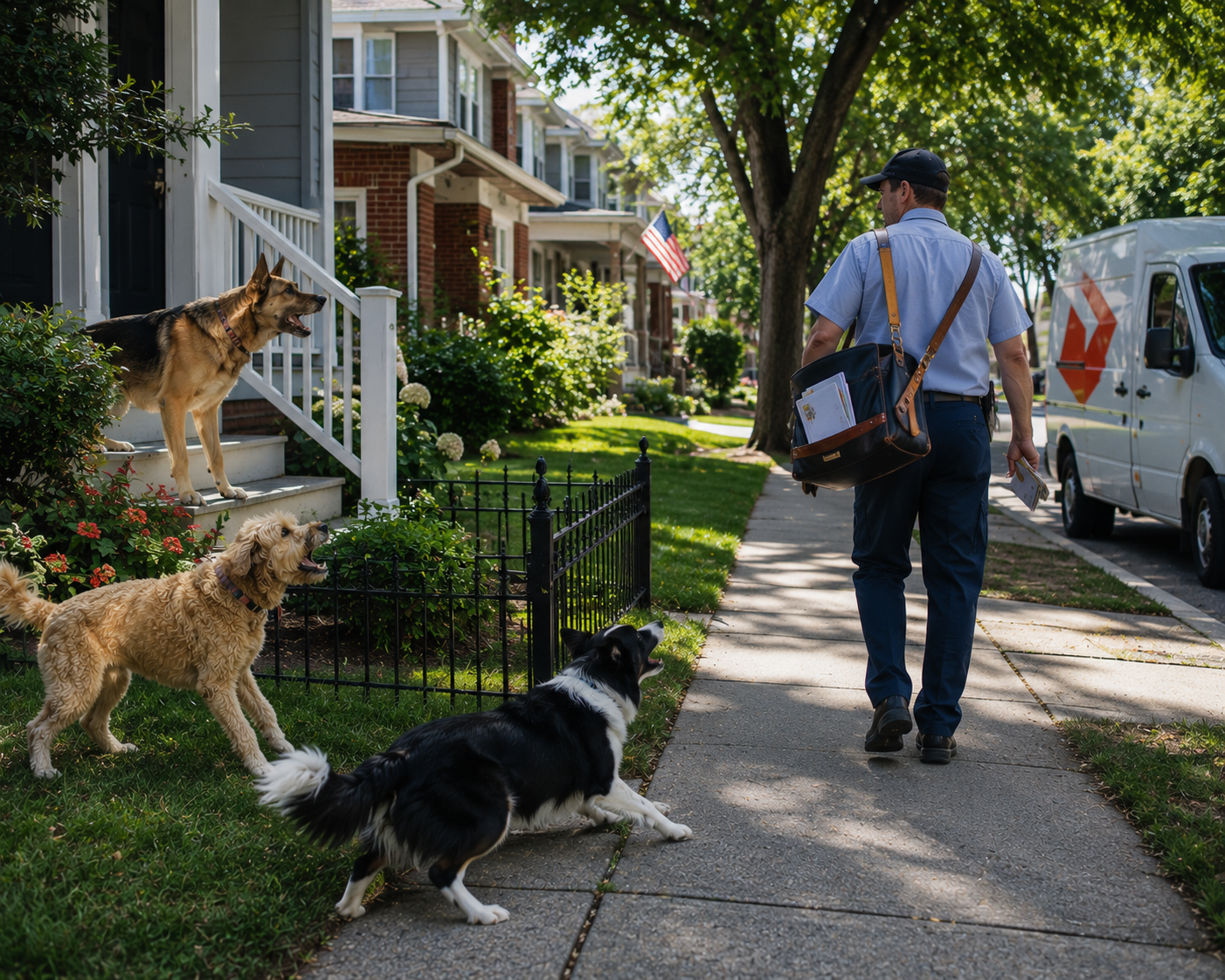
Nervous Around Mail Carriers: Why Dogs Become Nervous Around Mail Carriers
Many owners notice that their dog seems perfectly relaxed around neighbors or visitors but suddenly begins barking, growling, pacing, or rushing to the window the moment the mail carrier approaches. If your dog is nervous around mail carriers, you’re not alone. This is one of the most common behavior concerns reported by dog owners.
Mail carriers create a unique situation for dogs. Unlike guests who enter the home or neighbors who stop to chat, mail carriers typically approach the property, make brief movements near the front door or mailbox, and quickly leave. From a dog’s perspective, this unusual routine can feel unpredictable and even threatening.
Dogs that become nervous around mail carriers may:
- Bark repeatedly
- Growl
- Run to windows or fences
- Lunge at the front door
- Pace through the house
- Whine
- Pull on the leash during neighborhood walks
- Ignore commands
- Become difficult to redirect
- Remain alert long after the carrier has left
These reactions are often driven by emotional arousal rather than aggression. Some dogs feel protective of their home, while others simply become anxious around unfamiliar people wearing uniforms, carrying bags, or making unexpected movements.
Several factors may contribute to this behavior, including:
- Territorial instincts
- Repeated daily encounters
- Fear of unfamiliar people
- Limited socialization
- Anxiety
- Excitement
- Reinforced barking habits
- Lack of emotional regulation
The good news is that dogs can learn to feel more comfortable. Confidence-building exercises, controlled exposure, and teaching calm alternative behaviors help replace anxiety with trust. Instead of rushing to the door or barking at every delivery, dogs begin learning that the mail carrier is simply another part of everyday life.
For Bakersfield dog owners, improving this behavior creates a calmer household, reduces stress during deliveries, and helps dogs develop better emotional regulation in many other situations as well.
Key Takeaways
- Mail carriers often trigger territorial behavior.
- Barking is frequently reinforced because the carrier leaves after each visit.
- Nervous behavior usually stems from fear, uncertainty, or excitement rather than true aggression.
- Emotional regulation helps dogs remain calm.
- Positive reinforcement builds confidence.
- Controlled exposure reduces anxiety.
- Calm behaviors should be rewarded consistently.
- Avoid punishment, which may increase fear.
- Consistent training produces lasting improvement.
- Most dogs can learn to stay relaxed around mail carriers.
What Does “Nervous Around Mail Carriers” Mean?
When dogs are nervous around mail carriers, they react with barking, growling, pacing, lunging, or heightened alertness whenever the mail carrier approaches the home or passes nearby. While this behavior often appears aggressive, it is usually driven by excitement, uncertainty, territorial instincts, or anxiety rather than a genuine desire to attack.
Mail carriers create a unique situation for dogs.
Unlike invited guests, they:
- Approach the property.
- Walk directly toward the home.
- Deliver mail.
- Leave quickly.
- Return on a regular schedule.
From a dog’s perspective, this unusual pattern can seem suspicious.
Many dogs interpret the mail carrier as an unfamiliar person repeatedly entering their territory.
Dogs that become nervous around mail carriers may also:
- Run to the front window
- Bark continuously
- Charge the fence
- Pace through the house
- Pull on the leash outside
- Ignore commands
- Remain alert after the carrier leaves
- Whine
- Jump at doors
- React to delivery vehicles
These reactions usually reflect emotional arousal rather than true aggression.
Understanding the underlying emotion helps owners focus on building confidence instead of simply trying to stop the barking.
Why Mail Carriers Are Different
Dogs quickly learn predictable patterns.
Most visitors:
- Enter the home.
- Spend time with the family.
- Leave later.
Mail carriers behave differently.
They arrive.
Approach briefly.
Leave immediately.
This repeated pattern often becomes highly significant to dogs.
Why Dogs React to Mail Carriers
Several factors contribute to this common behavior.
Usually, more than one is involved.
Territorial Instincts
Dogs naturally pay attention to activity around their home.
Many consider their house and yard important territory.
When someone approaches:
- The front door
- The mailbox
- The driveway
- The fence
the dog’s protective instincts may become activated.
This does not necessarily mean the dog wants confrontation.
Often, they simply want the unfamiliar person to leave.
Unpredictable Appearance
Mail carriers may look different from everyday visitors.
Dogs often notice:
- Uniforms
- Hats
- Reflective clothing
- Large mailbags
- Handheld scanners
- Rolling carts
These unusual appearances may initially increase caution.
Daily Repetition
Unlike occasional guests, mail carriers usually appear on a predictable schedule.
Dogs quickly begin anticipating their arrival.
Some start barking before the carrier is even visible because they recognize:
- Delivery vehicle sounds
- Footsteps
- Mailbox noises
- Neighborhood routines
Repeated anticipation strengthens the habit.
Learning Through Association
Dogs constantly connect events.
For example:
The mail carrier arrives.
The dog barks.
The mail carrier leaves.
From the dog’s perspective:
“My barking made the person go away.”
Although the mail carrier was leaving regardless, the dog experiences a powerful sense of success.
This unintentionally reinforces barking every day.
Territorial Behavior vs. Fear
Not every dog reacts for the same reason.
Some feel protective.
Others feel uncertain.
The outward behaviors may appear similar.
Dogs Displaying Territorial Behavior May:
- Rush toward windows
- Stand tall
- Bark repeatedly
- Patrol the yard
- Watch the carrier closely
Their goal is often increasing distance between the home and the unfamiliar person.
Fearful Dogs May:
- Bark while backing away
- Tremble
- Hide behind furniture
- Avoid approaching doors
- Display tucked tails
- Refuse treats
These dogs are trying to create safety rather than defend territory.
Why Emotion Matters
Two dogs may bark equally loudly.
One feels confident.
The other feels frightened.
Understanding the underlying emotional state allows owners to choose more effective training methods.
Why Daily Deliveries Reinforce Barking
Mail carrier reactions often become stronger over time because the behavior is reinforced almost every day.
Each visit follows a similar sequence.
The carrier approaches.
The dog barks.
The carrier leaves.
The dog’s brain concludes:
“My behavior worked.”
This reinforcement occurs even though the carrier always intended to leave after delivering the mail.
Over weeks and months, barking becomes an automatic response.
Why Habits Become Stronger
The more often behaviors succeed, the stronger they become.
Daily repetition creates:
- Faster reactions
- Louder barking
- Earlier anticipation
- Increased emotional arousal
Eventually, some dogs react simply by hearing the delivery truck.
Body Language Before Barking
Dogs almost always communicate through body language before vocalizing.
Recognizing these early signals allows owners to intervene before barking escalates.
Common signs include:
- Freezing
- Stiff posture
- Closed mouth
- Raised ears
- Hard staring
- Tail becoming still
- Rapid scanning
- Walking toward the window
- Looking repeatedly outside
- Increased breathing
These subtle behaviors often appear several seconds before barking begins.
Escalation Happens Gradually
Most dogs follow a predictable sequence.
First:
They hear a sound.
Then:
They investigate.
Next:
Their body stiffens.
Finally:
They bark or rush toward the door.
Intervening during the earliest stages is much easier than trying to interrupt full emotional arousal.
Emotional Regulation Around Visitors
Emotional regulation allows dogs to remain calm even when unfamiliar people approach the home.
Dogs with strong emotional regulation can:
- Notice the mail carrier.
- Stay relaxed.
- Respond to their owner’s cues.
- Recover quickly after the carrier leaves.
- Return to resting without prolonged excitement.
These skills develop gradually through repeated positive experiences.
Helpful exercises include:
- Place training
- Calm reward-based routines
- Watching visitors from a comfortable distance
- Engagement games
- Impulse-control exercises
- Confidence-building activities
- Rewarding quiet behavior
Rather than reacting automatically every time someone approaches the house, dogs learn that unfamiliar visitors do not always require a response. Over time, repeated positive experiences replace anxiety and overexcitement with confidence and emotional balance. As this self-control develops, many dogs become far more relaxed around mail carriers, delivery drivers, and other everyday visitors, creating a calmer household and a more confident companion.
Common Owner Mistakes
When dogs are nervous around mail carriers, owners often react with good intentions but accidentally reinforce the behavior. Because mail delivery happens almost every day, these repeated interactions quickly become established habits.
Understanding common mistakes helps owners replace fear and overexcitement with confidence and self-control.
Yelling at the Dog
When barking starts, many owners respond by yelling:
- “Quiet!”
- “Stop!”
- “No!”
Although the goal is to stop the barking, dogs often interpret raised voices as additional excitement.
From the dog’s perspective:
“Everyone is reacting. Something really is happening.”
Instead of lowering emotional arousal, yelling may increase it.
Calm, consistent responses are usually far more effective.
Pulling the Dog Away Suddenly
Dragging a barking dog away from the window or front door often creates frustration rather than relaxation.
Instead:
- Calmly call your dog away.
- Reward voluntary movement.
- Redirect them to another activity.
- Reinforce quiet behavior.
Teaching an alternative behavior is more productive than relying on physical restraint.
Waiting Until Barking Begins
Many owners only react after their dog is already barking.
By that point, emotional arousal is high.
Instead, watch for early body language such as:
- Looking toward the window
- Stiff posture
- Pausing suddenly
- Raised ears
- Quiet alertness
Intervening early is much easier than interrupting a fully developed barking episode.
Punishing Fear
If your dog feels uncertain around mail carriers, punishment often increases anxiety.
Fear cannot be corrected through intimidation.
Instead, focus on creating positive associations that help your dog feel safe.
Inconsistent Responses
Some days owners ignore barking.
Other days they scold it.
Sometimes they comfort the dog.
Sometimes they laugh.
This inconsistency makes learning much more difficult.
Choose one calm, predictable response and practice it consistently.
Teaching Calm Responses to Mail Carriers
The goal is not simply to stop barking.
The goal is helping your dog remain emotionally relaxed whenever the mail carrier appears.
Teach Place
One of the most useful exercises is Place training.
Instead of running to the door, your dog learns to:
- Go to their bed.
- Lie down.
- Relax.
- Wait calmly.
Over time, this becomes the automatic response whenever someone approaches the house.
Reward Quiet Observation
If your dog notices the mail carrier but remains calm:
- Praise quietly.
- Offer a reward.
- Continue normal household activities.
This teaches your dog that remaining calm is rewarding.
Create Positive Associations
Whenever the mail carrier appears:
- Scatter treats on the floor.
- Offer a stuffed enrichment toy.
- Practice calm engagement.
Eventually, the dog’s emotional response changes from concern to positive anticipation.
Practice Engagement
Teach your dog that checking in with you is more rewarding than staring out the window.
Reward eye contact frequently during quiet moments.
This habit often transfers naturally to real-life situations.
Build Confidence Gradually
Confidence grows through repeated success.
Rather than expecting perfect behavior immediately, celebrate small improvements such as:
- Shorter barking episodes
- Faster recovery
- Looking at you voluntarily
- Remaining farther from the door
- Accepting treats during deliveries
These small victories add up over time.
Nervous Around Mail Carriers in Bakersfield
Mail and package deliveries are part of daily life throughout Bakersfield neighborhoods.
Whether you live in:
- A suburban neighborhood
- A rural property
- An apartment community
- A gated development
your dog is likely to encounter:
- USPS mail carriers
- Package delivery drivers
- Grocery deliveries
- Utility workers
- Maintenance personnel
Professional dog training helps Bakersfield owners improve:
- Emotional regulation
- Confidence around visitors
- Place training
- Impulse control
- Household manners
- Calm responses to everyday deliveries
These same skills also improve behavior around guests, neighbors, and other unfamiliar people approaching the home.
Long-Term Benefits of Confidence-Based Training
Teaching calm responses to mail carriers creates improvements that extend well beyond deliveries.
Long-term benefits include:
- Reduced barking
- Better emotional regulation
- Increased confidence
- Improved impulse control
- Less household stress
- Better focus during training
- Improved visitor manners
- Stronger owner engagement
- Greater adaptability
- Safer home behavior
Dogs that learn to remain calm around one type of visitor often become more relaxed around many other everyday situations.
Frequently Asked Questions
1. Why does my dog bark at the mail carrier every day?
Because the mail carrier approaches your home and then leaves, your dog may believe their barking successfully made the person go away. This repeated pattern reinforces the behavior.
2. Is my dog protecting me?
Sometimes, but not always. Many dogs are reacting out of territorial instincts, excitement, or uncertainty rather than intentionally protecting their owners.
3. Why doesn’t my dog bark at every visitor?
Mail carriers behave differently than most guests. They approach briefly, avoid interaction, leave quickly, and repeat the routine almost every day.
4. Should I punish my dog for barking?
No. Punishment may increase fear or excitement. It is generally more effective to teach calm alternative behaviors and reward emotional regulation.
5. Can puppies develop this habit?
Yes. Puppies often begin reacting to repeated daily events if calm behavior is not reinforced early.
6. Does Place training help?
Absolutely. Place gives dogs a clear, rewarding alternative to running toward the door whenever someone approaches.
7. Can professional training improve this behavior?
Yes. Professional trainers can develop confidence-building exercises and household routines that reduce barking and improve self-control.
8. Why does my dog keep barking after the mail carrier leaves?
Some dogs remain emotionally aroused even after the trigger disappears. Relaxation training helps shorten recovery time.
9. Will my dog eventually ignore the mail carrier?
Most dogs improve significantly with consistent positive training. While they may still notice the mail carrier, they often learn to remain calm instead of barking excessively.
10. Can this training help with delivery drivers too?
Yes. The same confidence-building techniques apply to package deliveries, utility workers, landscapers, and other unfamiliar visitors.
Comprehensive Conclusion
Nervous Around Mail Carriers is one of the most common household behavior concerns because mail delivery combines several powerful triggers for dogs. An unfamiliar person approaches the home, moves through the dog’s perceived territory, and then leaves shortly afterward. From the dog’s point of view, barking appears to make the person go away, reinforcing the behavior day after day. While these reactions may seem protective, they are often rooted in excitement, uncertainty, territorial instincts, or anxiety rather than true aggression.
The encouraging news is that this behavior can improve through confidence-based training. Teaching alternative responses such as Place, rewarding calm observation, creating positive associations with deliveries, and practicing emotional regulation all help dogs learn that mail carriers are simply another predictable part of daily life. As dogs gain confidence, they recover more quickly from the excitement of deliveries and become less likely to bark or rush toward the door.
For Bakersfield dog owners, these same training techniques provide benefits far beyond mail delivery. Dogs that remain calm around mail carriers often show improved behavior when visitors arrive, neighbors walk past the home, or service professionals approach the property. The emotional regulation learned in one situation transfers to many others, creating a quieter household and reducing stress for everyone involved.
Ultimately, successful training is about changing how your dog feels, not just how they behave. By replacing uncertainty with positive experiences and rewarding calm choices consistently, most dogs learn that there is no need to sound the alarm every time the mail arrives. Over time, confidence replaces anxiety, barking decreases, and both dogs and their families enjoy a more peaceful daily routine.
Website Contact Form
"*" indicates required fields