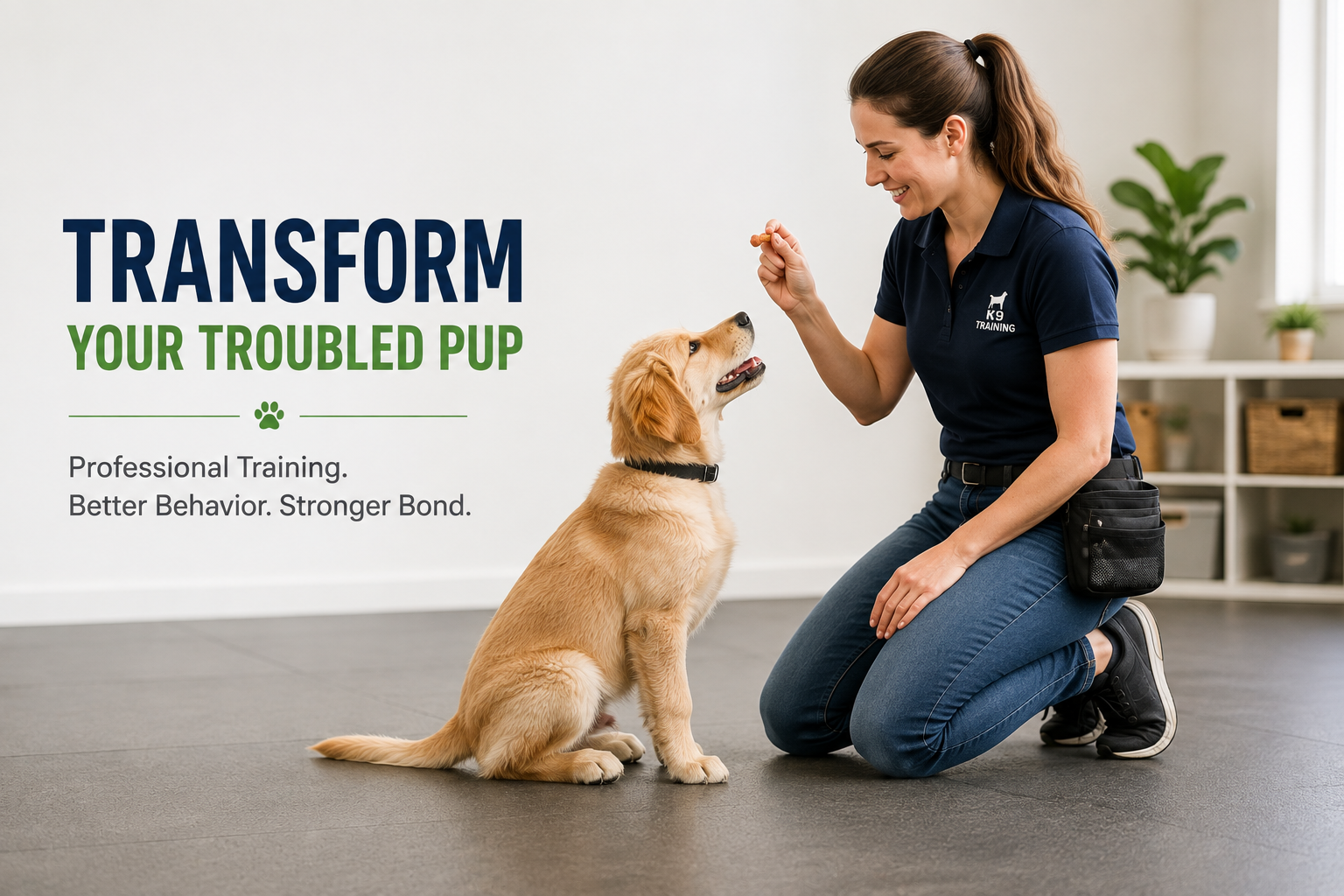
Transform Your Troubled Pup With Professional Dog Training
Living with a dog that struggles with behavior can be frustrating.
Maybe your puppy jumps on everyone who walks through the door.
Maybe your dog pulls so hard on walks that going outside feels like work.
Perhaps barking has become a constant part of your household routine.
Or your dog becomes overwhelmed around visitors, other dogs, unfamiliar places, or everyday distractions.
These challenges can leave owners wondering whether their dog will ever become easier to manage.
The good news is that many unwanted behaviors can be improved with the right training approach.
Professional dog training is not about forcing a dog to behave perfectly. It is about understanding why the behavior is happening, identifying what the dog needs to learn, and creating a structured path toward better behavior.
When owners want to transform your troubled pup, the most productive approach is to focus on skills rather than simply suppressing unwanted behavior.
A dog that jumps may need impulse control and calm greeting skills.
A dog that pulls may need better engagement and leash skills.
A fearful dog may need confidence-building and gradual exposure.
A reactive dog may need careful management and behavior modification.
The training plan should match the individual dog.
Professional support can also help owners understand what to expect from the process. Meaningful behavior change usually requires repetition, consistency, and participation from the entire household.
The transformation is not simply about having a dog that follows commands.
It is about creating a dog that can make better choices, recover from excitement, communicate appropriately, and function more successfully in everyday life.

Key Takeaways
- Professional dog training begins by identifying the underlying reasons for unwanted behavior.
- Different behavior problems require different training strategies.
- Positive reinforcement can make desirable behaviors more rewarding.
- Owners play an important role in maintaining progress between sessions.
- Training should be realistic and connected to everyday situations.
- Behavior change usually develops gradually rather than overnight.
- Puppies and adult dogs can both benefit from individualized training.
- Confidence, impulse control, focus, and emotional regulation are important parts of behavior improvement.
- Management helps prevent unwanted behaviors from being repeatedly practiced.
- The long-term goal is a more confident, responsive, and manageable companion.
What Does “Transform Your Troubled Pup” Mean?
To transform your troubled pup does not mean changing your dog’s personality or expecting perfect behavior overnight. It means helping a dog develop better habits, stronger communication, improved confidence, and practical skills that make everyday life easier.
A dog may be considered “troubled” when certain behaviors repeatedly create challenges at home or in public.
These may include:
- Excessive barking
- Jumping on people
- Leash pulling
- Poor impulse control
- Difficulty settling
- Reactivity toward dogs or people
- Fear of unfamiliar situations
- Destructive behavior
- Ignoring familiar cues around distractions
- Difficulty with household boundaries
These behaviors can have very different causes.
A puppy may jump because they are excited and have not learned an appropriate greeting.
A dog may bark because they are fearful, frustrated, territorial, or simply have learned that barking produces a response.
A dog that pulls on walks may be motivated by smells, movement, excitement, or a lack of leash skills.
Professional training begins by understanding the behavior rather than simply labeling the dog as “bad.”
Transformation Is a Process
Real behavior change usually happens through repeated practice.
A typical progression may look like:
The goal is to give the dog better choices.
Instead of jumping, the dog learns to sit or keep four paws on the floor.
Instead of pulling toward a distraction, the dog learns to reconnect with the handler.
Instead of reacting immediately, the dog learns to pause and respond.
That is what meaningful transformation looks like.
Why Dogs Develop Challenging Behaviors
Dogs rarely develop difficult behaviors for no reason.
Behavior is influenced by a combination of genetics, learning history, environment, development, reinforcement, and individual temperament.
Puppies Are Still Learning
Young puppies have limited impulse control.
They explore the world through:
- Movement
- Play
- Chewing
- Sniffing
- Chasing
- Social interaction
Without appropriate guidance, normal puppy behaviors can become inconvenient household habits.
Early training helps puppies learn what is appropriate before unwanted behaviors become deeply established.
Dogs Learn From Consequences
Dogs repeat behaviors that produce valuable outcomes.
If barking consistently results in attention, the dog may bark more.
If jumping results in petting, the behavior can become stronger.
If pulling allows the dog to reach an interesting smell, pulling may become rewarding.
This is why changing the dog’s behavior often requires changing what happens immediately afterward.
Fear Can Drive Behavior
Some challenging behaviors are rooted in discomfort.
A fearful dog may:
- Hide
- Bark
- Growl
- Retreat
- Freeze
- Lunge
These behaviors should not automatically be treated as disobedience.
The dog may be communicating that a situation feels unsafe.
Training should address the emotional component while teaching appropriate responses.
Lack of Structure
Dogs benefit from clear, predictable expectations.
Without consistent boundaries, a dog may not understand:
- Where to settle
- How to greet people
- When play ends
- How to wait
- How to respond to distractions
- Which behaviors earn reinforcement
Structure gives dogs information they can use.
Insufficient Appropriate Outlets
Some dogs have significant physical or mental needs.
When those needs are not appropriately met, dogs may seek their own activities.
This can contribute to:
- Destructive chewing
- Excessive attention-seeking
- Restlessness
- Chasing
- Household disruption
Training works best when combined with appropriate enrichment, exercise, rest, and routine.
When Professional Dog Training Can Help
Professional training can be valuable whenever owners feel stuck or uncertain about how to address a recurring behavior.
Persistent Everyday Problems
Professional guidance can help with common concerns such as:
- Jumping
- Pulling
- Barking
- Poor recall
- Counter surfing
- Door manners
- Excessive excitement
- Difficulty settling
These may seem like small problems individually, but they can significantly affect household life when they happen every day.
Behavior That Creates Safety Concerns
Professional assistance becomes particularly important when behavior involves:
- Lunging
- Biting
- Aggression
- Escaping
- Chasing vehicles
- Severe reactivity
Safety and appropriate management should come first.
Training Isn’t Working at Home
Owners sometimes spend weeks repeating the same exercises without seeing improvement.
The problem may not be a lack of effort.
The training environment, timing, reward strategy, progression, or expectations may simply need adjustment.
A professional can observe the interaction and identify opportunities that are difficult for owners to recognize themselves.
Major Household Changes
Training can also help when a dog’s environment changes.
Examples include:
- Moving to a new home
- Introducing a new pet
- Welcoming a baby
- Changing household schedules
- Adopting an adult dog
- Bringing home a puppy
Predictable routines and clear expectations can help dogs adjust.
What to Expect During a Professional Training Program
Professional dog training should be individualized.
There is no universal program that produces identical results for every dog.
Initial Assessment
The process commonly begins by gathering information about:
- The dog’s age
- Breed or breed mix
- History
- Daily routine
- Environment
- Behavior concerns
- Training experience
- Triggers
- Owner goals
The trainer may also observe the dog’s behavior directly.
Understanding the context is essential.
Establishing Goals
Rather than simply saying “make my dog behave,” owners and trainers can identify measurable objectives.
For example:
Instead of:
“My dog is out of control.”
Use:
“My dog should greet visitors without jumping.”
Or:
Instead of:
“My dog is terrible on walks.”
Use:
“My dog should walk with a loose leash for portions of our neighborhood walks.”
Clear goals make progress easier to recognize.
Teaching New Behaviors
The trainer introduces behaviors that can replace unwanted actions.
For example:
Jumping → four paws on the floor
Door rushing → waiting
Demand barking → calm communication
Poor focus → attention to handler
The dog learns what to do rather than simply being told what not to do.
Practicing in Appropriate Environments
Training should eventually move beyond the quiet training area.
Dogs need opportunities to practice around realistic distractions.
The difficulty should increase gradually.
A dog may first practice at home, then in the yard, then in a quiet outdoor environment, and eventually around more challenging distractions.
Owner Participation
Professional training does not mean the trainer does all the work.
Owners need to understand the techniques and continue practicing them.
The strongest results usually come when training becomes part of everyday life rather than remaining something that happens only during scheduled sessions.
Common Behavior Problems Professional Training Addresses
Professional dog training can address a wide range of behaviors.
Leash Pulling
Dogs may pull because they are excited, distracted, curious, or eager to reach something.
Training can teach engagement, appropriate leash behavior, and better responses to distractions.
Jumping
Jumping is often reinforced accidentally because people respond to the dog.
Teaching calm greetings gives the dog a clearer alternative.
Excessive Barking
Barking can have many causes.
Effective training considers the reason for the barking rather than treating every bark the same way.
Reactivity
Reactive behavior can involve barking, lunging, staring, or intense responses toward particular triggers.
These cases often require careful management, gradual exposure, and individualized behavior modification.
Poor Impulse Control
Some dogs struggle to wait for:
- Food
- Doors
- Toys
- Attention
- Walks
- Greetings
Impulse-control exercises can help dogs learn that patience has rewards.
Difficulty Settling
A dog that constantly moves, demands attention, or follows household activity may need help learning how to relax.
Teaching calmness can improve both the dog’s quality of life and the owner’s experience.
The Role of Positive Reinforcement
Positive reinforcement is an important component of effective dog training.
The basic principle is straightforward:
The reward might be:
- Food
- Praise
- Play
- Access to something the dog wants
- A favorite activity
- Opportunity to sniff or explore
Reward the Behavior You Want
If a dog sits calmly instead of jumping, reinforce the sitting.
If the dog looks toward the owner instead of pulling toward a distraction, reinforce that choice.
If the dog settles quietly on a mat, reward the relaxation.
The dog learns which behaviors work.
Timing Matters
Rewards are most useful when they occur close to the behavior being reinforced.
Clear timing helps the dog understand:
“That behavior caused the reward.”
Positive Reinforcement Is Not the Same as Bribery
A reward can be used to teach a behavior without permanently requiring food in the owner’s hand.
As the behavior becomes stronger, rewards can be adjusted while reinforcement continues in appropriate ways.
The goal is to build reliable habits.
Building Confidence, Focus, and Impulse Control
A truly transformed dog is not simply one that knows more commands.
The dog should also become better equipped to handle everyday situations.
Confidence
Confidence can help dogs approach unfamiliar environments with greater composure.
Training should challenge the dog without overwhelming them.
Focus
Dogs need to learn how to reconnect with their owners despite distractions.
This is especially important during:
- Walks
- Public outings
- Visitor greetings
- Training sessions
- Neighborhood activities
Impulse Control
A dog that can pause before acting has more opportunities to make appropriate choices.
Waiting for a food bowl, remaining at a doorway, or looking toward an owner instead of chasing a distraction are all examples of useful impulse control.
Emotional Regulation
Dogs also need recovery skills.
A dog may become excited by a visitor or distracted by another dog, but learning how to settle afterward is an important part of behavior development.
Ultimately, professional training should help create a dog that is not merely obedient in a quiet room, but more capable of thinking, responding, and recovering in the real world.
Common Owner Mistakes
When owners want to transform your troubled pup, it is understandable to want quick results. However, some common approaches can unintentionally make training harder or create confusion for the dog.
Expecting Overnight Results
Behavior change takes repetition.
A dog may improve during one training session and struggle again the next day. That does not necessarily mean the training failed.
Dogs need repeated opportunities to practice the desired behavior in different situations.
Inconsistent Household Rules
Training becomes difficult when one person allows a behavior while another person discourages it.
For example, if jumping is discouraged when guests arrive but encouraged during play, the dog receives mixed information.
Everyone in the household should understand the basic expectations.
Only Correcting Unwanted Behavior
Telling a dog what not to do does not necessarily teach them what they should do instead.
Rather than focusing exclusively on:
“Don’t jump.”
teach:
“Keep your paws on the floor.”
Instead of:
“Don’t pull.”
teach:
“Stay connected to the handler.”
Clear alternatives make learning easier.
Practicing Only at Home
A dog may perform beautifully in a quiet room but struggle outdoors.
Dogs need practice in increasingly realistic environments so their skills become transferable.
Using Too Much Pressure
Harsh or intimidating techniques can increase fear, frustration, or conflict in some dogs.
Training should prioritize safety, clear communication, appropriate reinforcement, and the individual dog’s emotional state.
Ignoring the Dog’s Environment
Sometimes owners focus heavily on commands while overlooking what is happening around the dog.
A dog may be struggling because of:
- Too much noise
- Too many distractions
- Lack of rest
- Excessive excitement
- Fear
- An unfamiliar environment
Changing the environment can sometimes make learning much easier.
How Owners Support Training at Home
Professional instruction is most effective when owners continue practicing between sessions.
The goal is not to turn every moment at home into a formal training exercise. Instead, owners can incorporate short opportunities for learning into normal routines.
Practice in Short Sessions
Several brief sessions can be easier for a dog than one long session.
For example:
Two to five minutes of focused practice → break → normal activity.
Short sessions can help maintain attention and reduce frustration.
Reinforce Good Choices Throughout the Day
Training opportunities happen constantly.
Reward your dog for:
- Waiting calmly
- Coming when called
- Settling independently
- Walking politely
- Looking toward you
- Keeping four paws on the floor
- Responding to a familiar cue
These everyday repetitions help desirable behaviors become habits.
Create Predictable Routines
Dogs often benefit from knowing what to expect.
Consistent routines can include:
- Regular feeding
- Walks
- Rest periods
- Training
- Play
- Quiet time
Predictability can make expectations easier to understand.
Manage the Environment
Training is not only about teaching.
Management helps prevent unwanted behaviors from being repeatedly rehearsed.
For example, if a dog jumps on visitors, owners can use distance, gates, leashes, or a designated resting area while teaching appropriate greetings.
Management gives the dog fewer opportunities to practice the unwanted behavior while new skills are developing.
Practice Around Gradual Distractions
Once a behavior is reliable at home, begin introducing manageable distractions.
For example:
Living room → backyard → quiet sidewalk → neighborhood → busier environment.
If the dog struggles, make the exercise easier.
Progress should be based on the dog’s ability to remain engaged rather than on a predetermined schedule.
Communicate With the Trainer
Owners should share both successes and setbacks.
If a dog suddenly begins struggling with a behavior, the training plan may need to be adjusted.
Good communication allows training to remain individualized.
Transform Your Troubled Pup in Bakersfield
For Bakersfield families, professional dog training can provide practical support for dogs struggling with everyday behavior.
Dogs may encounter many challenges in their normal routines, including:
- Neighborhood distractions
- Other dogs
- Visitors
- Children
- Traffic
- Wildlife
- New environments
- Household activity
- Public spaces
A dog that behaves well inside the home may still need additional practice before those skills become reliable outside.
Professional training can focus on practical goals such as:
- Puppy manners
- Basic obedience
- Leash skills
- Impulse control
- Calm greetings
- Recall
- Focus around distractions
- Household manners
- Confidence building
- Behavior modification
The training approach should be based on the individual dog’s behavior, temperament, learning history, and the owner’s goals.
Training for Everyday Life
The objective is not simply to have a dog that performs commands during a lesson.
Owners want skills they can use during real situations.
That might mean:
Calmly greeting a visitor.
Walking without constantly pulling.
Responding when called.
Settling while the family is busy.
Remaining manageable around distractions.
These practical behaviors can make a significant difference in the relationship between dogs and their families.
Long-Term Benefits of Professional Dog Training
Professional training can provide benefits that extend beyond the original behavior problem.
Better Communication
Training gives owners and dogs a clearer way to communicate.
The dog learns what behaviors are valuable, while the owner becomes better at recognizing the dog’s needs and signals.
Greater Confidence
Dogs that successfully learn new skills can become more comfortable navigating unfamiliar situations.
Confidence is especially valuable for dogs that are cautious, easily overwhelmed, or uncertain in new environments.
Improved Impulse Control
A dog that learns to pause before acting can make better choices around:
- Food
- Toys
- People
- Dogs
- Doors
- Wildlife
- Environmental distractions
Stronger Household Relationships
When owners understand how to respond consistently, everyday interactions can become less frustrating.
Clear expectations reduce confusion.
Safer Everyday Behavior
Reliable recall, leash skills, doorway manners, and impulse control can all contribute to safer daily routines.
Training cannot eliminate every risk, but stronger skills can provide owners with more options when unexpected situations occur.
More Enjoyable Outings
A dog that can walk calmly, respond around distractions, and settle in appropriate environments can participate more easily in family activities.
Training can therefore improve more than behavior.
It can expand what dogs and owners can comfortably do together.
Frequently Asked Questions
1. Can professional dog training really transform a difficult dog?
Many dogs can make meaningful behavioral improvements with appropriate training, consistency, management, and time. The specific outcome depends on the dog’s individual circumstances.
2. How quickly will I see results?
Some behaviors may improve quickly, while others require considerably more time. Long-term reliability generally comes from repeated practice rather than a single training session.
3. Is professional training only for aggressive dogs?
No. Professional training can help with everyday concerns such as jumping, leash pulling, barking, poor recall, impulse control, household manners, and difficulty settling.
4. Can older dogs still benefit from training?
Yes. Adult and senior dogs can learn new behaviors. Training plans should account for the dog’s physical abilities, history, temperament, and individual needs.
5. Is positive reinforcement effective for difficult behaviors?
Positive reinforcement can be a valuable part of teaching dogs desirable alternatives and strengthening behaviors owners want to see more often. More complex cases may require a broader individualized behavior plan.
6. What if my dog behaves differently with the trainer?
That is useful information rather than a failure.
Dogs can behave differently depending on the person, environment, routine, and consequences involved. Owner participation helps transfer training into everyday life.
7. Do I need to practice every day?
Regular practice is generally helpful. Even short sessions and reinforcement during normal daily activities can contribute to progress.
8. Can training stop barking completely?
Barking is normal canine communication, so eliminating all barking is usually not a realistic goal. Training can instead focus on reducing excessive barking and teaching appropriate responses.
9. What if my dog is fearful or reactive?
Fearful or reactive behavior should be approached carefully. Avoid forcing the dog into situations that overwhelm them. A qualified professional can help create an appropriate behavior-modification plan, and veterinary input may be appropriate when significant fear or aggression is involved.
10. How do I know which training program is right for my dog?
Start with the specific behavior you want to change, your dog’s history, your environment, and your goals. A professional evaluation can help determine what approach and level of support are appropriate.
Comprehensive Conclusion
To transform your troubled pup is not about turning a challenging dog into a completely different animal.
It is about helping the dog become more capable.
A dog that once jumped on every visitor can learn to greet people calmly.
A dog that pulled constantly can learn better leash habits.
A dog that struggled with impulse control can learn to wait.
A dog that became overwhelmed by distractions can learn to reconnect with their owner.
A fearful or uncertain dog can gradually develop better coping skills when training respects their emotional limits.
The foundation is understanding the behavior.
Dogs behave according to their learning history, environment, emotions, genetics, reinforcement, and individual temperament. Effective training considers those factors instead of assuming every unwanted behavior has the same explanation.
Professional training can provide structure, guidance, and a customized plan. But the owner’s role remains essential.
The strongest progress happens when training continues between professional sessions.
Short practice sessions, consistent household rules, appropriate management, positive reinforcement, and gradual exposure to real-world situations can turn individual exercises into lasting habits.
It is also important to have realistic expectations.
Behavior change is rarely perfectly linear. Dogs can have good days and difficult days. A setback does not erase previous progress.
What matters is continuing to reinforce appropriate behavior and adjusting the difficulty when necessary.
For Bakersfield dog owners, professional training can provide practical tools for navigating everyday challenges—from leash walking and household manners to distractions, visitors, impulse control, and confidence.
Ultimately, a successful training program should produce more than a dog that knows commands.
It should help create a dog that can listen, make better choices, recover from excitement, and function more comfortably in everyday life.
That is the real transformation: not changing who your dog is, but helping them become the best-behaved and most confident version of themselves.
Website Contact Form
"*" indicates required fields