Teaching Dogs Appropriate Play Skills: How to Build Safe, Healthy Play Behavior
Play is one of the most important parts of a dog’s life. It provides physical exercise, mental stimulation, social interaction, and opportunities to practice communication. However, not every dog automatically knows how to play appropriately.
Some dogs become overly excited and:
- Jump on other dogs
- Chase constantly
- Nip during play
- Grab clothing
- Bark excessively
- Refuse to disengage
- Play too roughly
- Become frustrated when play ends
These behaviors do not necessarily mean a dog is aggressive. Often, the dog simply has not learned how to regulate excitement or recognize when another dog or person needs space.
This is why appropriate play skills are so important.
Healthy play involves more than running around. Dogs need to learn how to:
- Initiate play appropriately
- Respond to another dog’s signals
- Take breaks
- Control biting and mouthing
- Disengage when asked
- Transition from excitement to calm
- Respect boundaries
- Re-engage appropriately
Puppies especially benefit from learning these skills early. Their natural curiosity and enthusiasm can quickly become overwhelming without guidance.
Teaching appropriate play skills also helps owners distinguish healthy play from interactions that are becoming unsafe or excessively intense.
For Bakersfield dog owners, these skills can make playtime at home, in training environments, and around other dogs much safer and more enjoyable.
Key Takeaways
- Appropriate play skills help dogs interact safely.
- Play is important for physical and mental development.
- Not every dog naturally understands appropriate boundaries.
- Puppies need guidance as they learn to control excitement.
- Healthy play includes pauses and opportunities to disengage.
- Body language helps determine whether play is appropriate.
- Positive reinforcement teaches dogs better choices.
- Structured play improves impulse control.
- Supervision is important when dogs interact.
- Early play training supports confident, well-mannered adult dogs.
What Does “Appropriate Play Skills” Mean?
Appropriate play skills are the behaviors that allow dogs to play safely, communicate effectively, control their excitement, and respect the boundaries of other dogs and people.
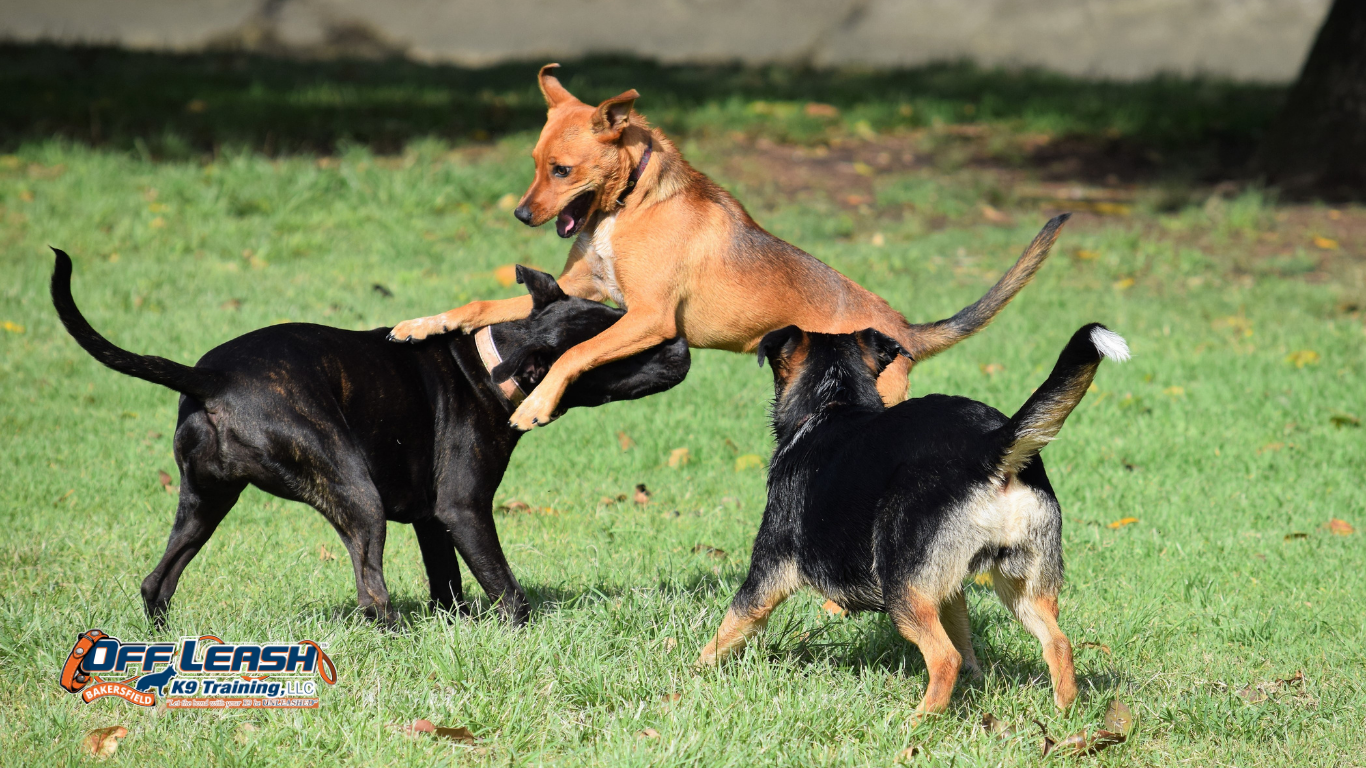
Play is naturally energetic. Dogs may chase, wrestle, tug, pounce, mouth, bark, and run. These behaviors are not automatically problematic. The important question is whether the dog can remain responsive, recognize social signals, and disengage when needed.
A dog with appropriate play skills can:
- Initiate play appropriately
- Respond to another dog’s signals
- Take breaks
- Control the intensity of play
- Release toys when asked
- Stop when play is over
- Redirect toward an appropriate toy
- Calm down after excitement
- Respect another dog’s space
Puppies are still developing these abilities, so they often need guidance from owners and appropriate play partners.
Why Dogs Need Healthy Play Skills
Play provides much more than physical exercise.
Healthy play helps dogs develop:
- Coordination
- Confidence
- Social communication
- Problem-solving skills
- Bite inhibition
- Impulse control
- Emotional regulation
For puppies, play can also provide important opportunities to learn how other dogs communicate.
A puppy may discover that another dog does not want to continue playing when that dog walks away or pauses. Learning to recognize these signals helps prevent inappropriate interactions later in life.
Play Builds Confidence
Positive play experiences can help dogs become more comfortable with new environments and social situations.
A confident dog is more likely to:
- Explore appropriately
- Recover after surprises
- Try new activities
- Communicate clearly
- Disengage when needed
Healthy play gives dogs opportunities to succeed without requiring them to remain constantly controlled.
Play Helps Release Energy
Dogs need appropriate outlets for natural behaviors.
Without enough physical and mental activity, some dogs may redirect their energy into:
- Jumping
- Barking
- Chewing
- Chasing
- Mouthing
- Destructive behavior
Structured play provides a constructive alternative.
Normal Play vs. Overly Rough Play
One of the most important parts of teaching appropriate play skills is learning to distinguish healthy play from interactions that are becoming too intense.
Signs of Healthy Play
Normal play often includes:
- Loose, relaxed body language
- Play bows
- Bouncy movements
- Taking turns chasing
- Brief pauses
- Self-handicapping
- Returning voluntarily to play
- Easy disengagement
Healthy dogs often switch roles naturally.
One dog chases.
Then the other dog chases.
They pause.
Then they resume.
This back-and-forth interaction is generally a positive sign.
Signs Play Is Becoming Too Rough
Play may need intervention when one dog:
- Cannot disengage
- Repeatedly ignores another dog’s attempts to escape
- Pins another dog continuously
- Chases without allowing breaks
- Becomes increasingly stiff
- Escalates vocalization
- Shows intense fixation
- Continues after the other dog clearly wants to stop
The key is not whether dogs make noise.
Some healthy play is very vocal.
Instead, look at the overall body language and whether both dogs are voluntarily participating.
Why Breaks Matter
Healthy play includes pauses.
Dogs may stop to:
- Sniff
- Drink water
- Explore
- Check their surroundings
- Interact with their owners
These breaks allow emotional arousal to decrease.
A dog that cannot pause may need help learning better self-control.
The Role of Impulse Control During Play
Impulse control is the ability to experience excitement without immediately acting on every urge.
This skill is especially important during play.
A dog may want to:
- Chase
- Grab
- Jump
- Bark
- Wrestle
Impulse control allows the dog to pause when necessary.
Why Puppies Struggle
Puppies have immature self-control.
Their brains are still developing, and exciting play can quickly overwhelm their ability to make thoughtful choices.
This is why puppies may suddenly:
- Bite harder
- Run wildly
- Jump on people
- Grab clothing
- Ignore their owners
These behaviors often indicate excessive excitement rather than intentional defiance.
Teaching Pause and Release
Simple exercises can teach puppies that excitement does not have to continue indefinitely.
Useful skills include:
- Wait
- Leave It
- Drop It
- Stay
- Place
- Come
These behaviors become especially valuable when practiced during short play sessions.
Ending Play Calmly
Dogs should learn that play has an ending.
A simple routine can be:
Play → pause → cue → reward → rest
This teaches the dog how to transition from excitement to relaxation.
Reading Dog Body Language During Play
Dogs communicate constantly through body language.
Learning to read these signals helps owners determine whether play is enjoyable or becoming uncomfortable.
Relaxed Body Language
Healthy play often includes:
- Loose muscles
- Wiggly movement
- Open mouth
- Soft eyes
- Relaxed tail
- Play bows
- Curved approaches
The dog’s body generally looks flexible rather than stiff.
Stress Signals
Pay attention when you see:
- Freezing
- Stiff posture
- Tail tucked tightly
- Repeated avoidance
- Turning away
- Hiding
- Lip licking
- Excessive yawning
These signs may indicate that a dog needs space.
The Importance of Consent
Dogs should not be expected to continue playing simply because another dog wants to.
A healthy interaction allows either dog to leave.
If one dog repeatedly walks away, hides, or avoids re-engagement, the interaction should end.
Respecting this boundary teaches dogs that communication works.
Emotional Regulation and Play
Excitement is a normal part of play.
The goal is not to eliminate excitement.
The goal is helping dogs regulate it.
A dog with good emotional regulation can become excited during play and then return to a calm state afterward.
This skill becomes useful in many other situations, including:
- Greetings
- Walks
- Training
- Family gatherings
- Public outings
- Visits from guests
Teaching Dogs to Come Down From Excitement
After an active play session, provide a calm transition.
For example:
- Put toys away.
- Ask for Place.
- Offer a safe chew.
- Encourage quiet rest.
- Reduce environmental stimulation.
Over time, dogs learn that high-energy activity has a predictable ending.
Structured Play Builds Better Habits
Rather than allowing play to become chaotic, owners can introduce simple structure.
For example:
- Begin with a calm cue.
- Start play.
- Pause periodically.
- Ask for a simple behavior.
- Resume play as a reward.
- End with relaxation.
This teaches dogs that listening does not mean fun disappears.
Instead, self-control becomes part of the game.
Teaching these skills consistently helps dogs understand that excitement and self-control can coexist. A dog does not have to become less playful to become better behaved. The goal is to create a dog that can enjoy running, tugging, chasing, and interacting while still recognizing boundaries, responding to their owner, and returning to a calm emotional state when play ends.