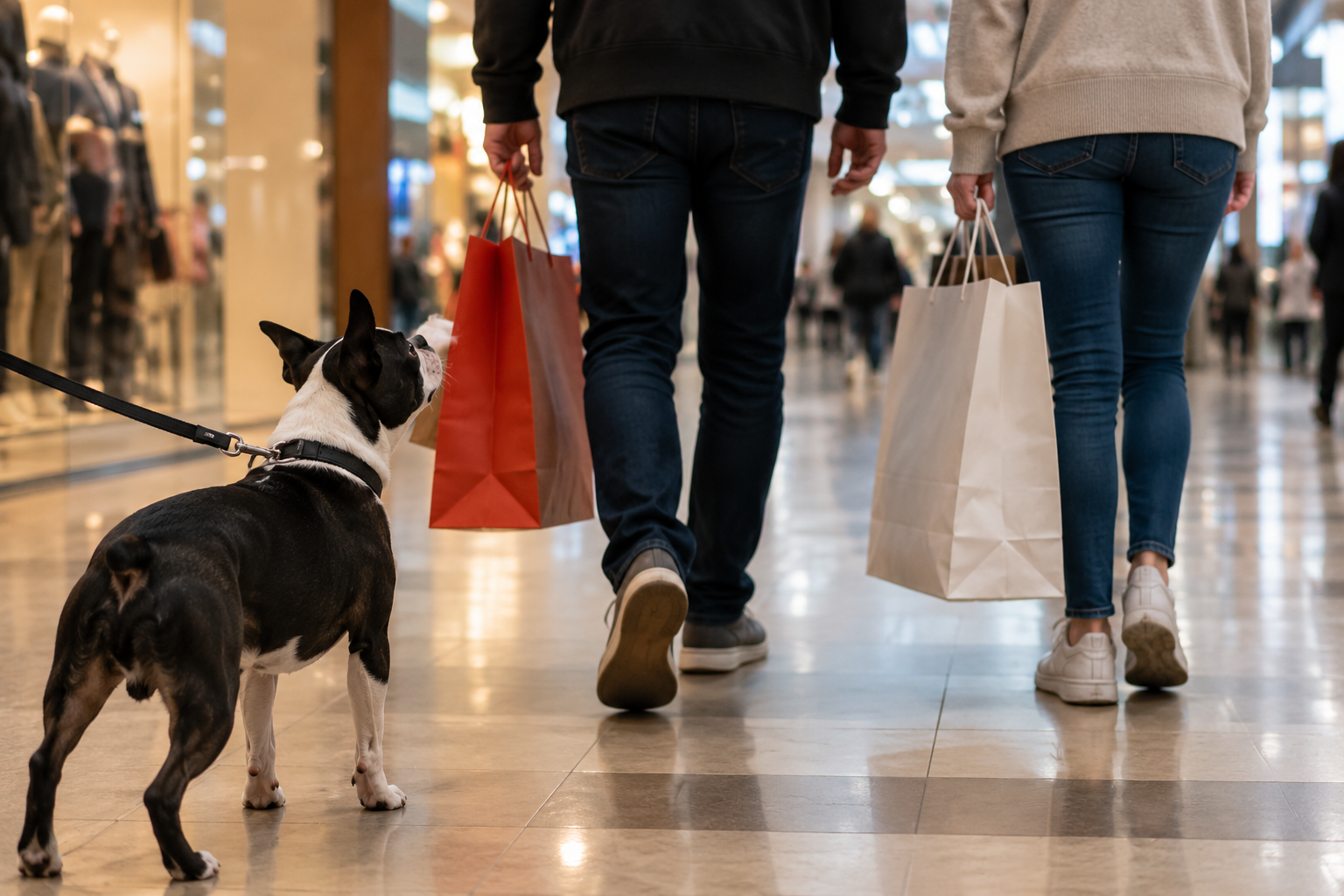
React to People Carrying Bags: Why Dogs React to People Carrying Bags
If your dog seems perfectly comfortable around people but suddenly begins barking, lunging, or freezing when someone walks by carrying a grocery bag, backpack, suitcase, or shopping bag, you’re not alone. Dogs that react to people carrying bags are displaying a surprisingly common behavior that often stems from uncertainty rather than aggression.
Dogs rely heavily on recognizing familiar patterns. When someone carries a large bag, their outline changes, their movements become less predictable, and the bag itself may swing, crinkle, or bump into objects. To a dog, this creates a very different picture than seeing someone walking empty-handed.
Dogs that react to people carrying bags may:
- Bark repeatedly
- Growl
- Lunge on the leash
- Freeze in place
- Hide behind their owner
- Pull away
- Stare intensely
- Ignore commands
- Refuse treats
- Remain alert after the person passes
These behaviors often result from emotional arousal rather than aggression. Some dogs become concerned because the bag looks unfamiliar, while others are startled by the sounds or movement it creates.
Several factors can contribute to this reaction, including:
- Limited socialization
- Fear of unfamiliar objects
- Sensitivity to movement
- Previous negative experiences
- Lack of confidence
- Territorial instincts
- General anxiety
- Poor emotional regulation
The encouraging news is that dogs can learn to feel comfortable around people carrying bags. By introducing these situations gradually, rewarding calm behavior, and helping dogs build confidence, owners can replace uncertainty with positive experiences.
For Bakersfield dog owners, this skill is especially valuable because dogs regularly encounter people carrying grocery bags, backpacks, shopping bags, sports equipment, and packages during neighborhood walks, park visits, and trips to pet-friendly businesses.
Key Takeaways
- Bags change a person’s appearance and movement.
- Dogs often react because the situation feels unfamiliar.
- Fear, uncertainty, and excitement can all cause reactions.
- Confidence-building reduces reactivity.
- Emotional regulation helps dogs remain calm.
- Gradual exposure is more effective than forced interactions.
- Reward calm observation consistently.
- Avoid punishing fearful behavior.
- Consistency builds lasting confidence.
- Most dogs improve with structured, positive training.
What Does “React to People Carrying Bags” Mean?
When dogs react to people carrying bags, they become noticeably more alert or emotional whenever someone walks by holding an unfamiliar object. A person carrying a grocery bag, backpack, suitcase, shopping bag, purse, toolbox, or package may suddenly trigger barking, growling, lunging, freezing, or attempts to move away.
Many owners find this confusing because their dog may happily greet people who are empty-handed.
The bag changes everything.
To a dog, a person carrying a large object looks, sounds, and moves differently than usual.
Dogs naturally notice changes in their environment.
When something appears unusual, they instinctively investigate whether it is safe.
Dogs that react to people carrying bags may:
- Bark repeatedly
- Growl
- Pull on the leash
- Freeze in place
- Hide behind their owner
- Lunge forward
- Stare intensely
- Refuse treats
- Ignore commands
- Remain alert after the person passes
These reactions usually reflect emotional arousal rather than aggression.
The dog is responding to uncertainty, excitement, or caution—not simply misbehaving.
Why Dogs Don’t Automatically Recognize Objects
Humans easily understand that:
A person with a backpack…
is still simply a person.
Dogs do not automatically make this connection.
Instead, they notice:
- Different body shapes
- New movement patterns
- Unfamiliar sounds
- Changing silhouettes
Each change requires evaluation.
Until the dog gains experience, unfamiliar objects often seem suspicious.
Why Dogs Notice Unusual Objects
Dogs constantly scan their surroundings for anything different.
Their brains quickly recognize patterns.
Anything that breaks those patterns naturally attracts attention.
Examples include:
- Grocery bags
- Trash bags
- Suitcases
- Backpacks
- Rolling luggage
- Shopping bags
- Large boxes
- Sports equipment
- Umbrellas
- Strollers
Many of these items move unpredictably or produce unfamiliar sounds.
Dogs instinctively investigate these changes.
Novelty Increases Attention
The less familiar an object is, the more attention it receives.
Dogs commonly react to objects that:
- Swing
- Bounce
- Drag behind people
- Roll
- Rustle
- Reflect sunlight
- Change a person’s outline
Novelty alone can increase emotional arousal.
Previous Experiences Matter
Some dogs have experienced frightening situations involving unusual objects.
Examples include:
- A shopping bag blowing toward them.
- A rolling suitcase making loud noises.
- A backpack brushing against them.
- A box falling nearby.
Even one unpleasant experience can influence future reactions.
Fear vs. Curiosity Around Bags
Not every dog reacting to bags is afraid.
Some simply become curious.
Others become excited.
The behaviors may appear similar while the emotions differ.
Fearful Dogs May:
- Freeze
- Pull away
- Bark while retreating
- Refuse treats
- Tremble
- Keep their tail tucked
Their goal is increasing distance from the unfamiliar object.
Curious Dogs May:
- Move closer
- Sniff repeatedly
- Watch carefully
- Circle the person
- Approach cautiously
These dogs are gathering information.
Excited Dogs May:
- Pull forward
- Jump
- Bark enthusiastically
- Wag rapidly
- Spin
- Rush toward the person
These dogs often want interaction rather than distance.
Why Understanding Emotion Matters
Two dogs may bark at the exact same person carrying groceries.
One feels frightened.
The other feels excited.
Training becomes much more effective when owners identify the underlying emotional state instead of focusing only on stopping the barking.
How Movement Changes a Dog’s Perception
Movement plays a major role in how dogs interpret the world.
People carrying bags rarely move normally.
Their walking pattern changes.
Objects swing.
Arms move differently.
Packages shift unexpectedly.
Dogs notice all of these subtle differences.
Unpredictable Motion Increases Alertness
Dogs naturally pay attention to movement.
Swinging objects often appear less predictable than stationary ones.
Examples include:
- Grocery bags swinging at someone’s side
- Plastic bags blowing in the wind
- Backpacks bouncing while jogging
- Shopping bags shifting position
- Rolling suitcases changing direction
The less predictable the movement, the more attention many dogs give it.
Why Noise Matters Too
Many bags produce unfamiliar sounds.
Examples include:
- Plastic crinkling
- Boxes rattling
- Bottles clinking
- Wheels rolling
- Handles tapping
Some dogs react to the sound before they even notice the person carrying the bag.
Body Language Before Reacting
Dogs almost always communicate through body language before barking or lunging.
Recognizing these signals allows owners to intervene early.
Common warning signs include:
- Freezing
- Closed mouth
- Hard staring
- Raised ears
- Slowing their pace
- Tail becoming still
- Lip licking
- Increased breathing
- Refusing treats
- Looking repeatedly toward the object
These signals often appear several seconds before barking begins.
Escalation Happens Gradually
Most reactions follow a predictable pattern.
The dog first notices the person.
Next:
Their attention locks onto the bag.
Then:
Their body stiffens.
Finally:
They bark, lunge, or attempt to move away.
Responding during the early stages is much easier than trying to interrupt full emotional arousal.
Emotional Regulation Around Unfamiliar Objects
Emotional regulation allows dogs to notice unusual objects without becoming overwhelmed.
Dogs with strong emotional regulation can:
- Observe calmly.
- Continue walking.
- Accept treats.
- Respond to cues.
- Recover quickly after the person passes.
These abilities develop gradually through repeated positive experiences.
Helpful confidence-building exercises include:
- Loose leash walking
- Engagement games
- Place training
- Rewarding calm observation
- Confidence walks
- Controlled exposure to everyday objects
- Positive reinforcement around unfamiliar sights
Rather than reacting automatically whenever someone carries a bag, dogs gradually learn that unusual objects are a normal part of everyday life. Each calm, successful encounter builds confidence and teaches the brain that there is no need to bark, lunge, or become anxious. Over time, curiosity replaces uncertainty, emotional regulation improves, and dogs become much more comfortable around people carrying grocery bags, backpacks, packages, luggage, and other everyday items.
Common Owner Mistakes
When dogs react to people carrying bags, owners often respond with good intentions but accidentally strengthen the behavior. Because these encounters happen regularly during neighborhood walks, shopping trips, and public outings, repeated reactions can quickly become habits.
Recognizing these common mistakes helps owners build confidence instead of increasing fear or excitement.
Pulling the Leash Tight
One of the most common reactions is tightening the leash as soon as someone carrying a bag appears.
While this is often done for safety, constant leash tension can increase:
- Frustration
- Anxiety
- Pulling
- Barking
- Lunging
Instead, whenever possible:
- Stay relaxed.
- Maintain a loose leash.
- Create additional distance if needed.
- Reward calm behavior.
A relaxed handler often helps create a calmer dog.
Forcing the Dog to Approach
Some owners believe their dog simply needs to “get over it.”
They encourage the dog to walk directly toward the unfamiliar person.
If the dog feels uncomfortable, forced exposure may increase fear rather than confidence.
Instead, allow your dog to observe from a distance where they can remain calm.
Confidence develops gradually.
Waiting Until Barking Starts
Many owners react only after barking begins.
By then, emotional arousal is already high.
Instead, watch for early warning signs such as:
- Stiff posture
- Hard staring
- Slowing down
- Closed mouth
- Raised ears
Redirecting your dog’s attention before barking starts is usually much easier.
Punishing Fear
If your dog is barking because they feel uncertain, punishment rarely improves the underlying emotion.
Instead, it may teach the dog that unfamiliar situations become even more unpleasant.
Focus on helping your dog feel safe through positive experiences.
Rushing Walks
Owners sometimes hurry past unfamiliar people.
While this may end the immediate situation, it gives the dog little opportunity to process the experience calmly.
Short pauses at a comfortable distance often encourage better emotional recovery.
Teaching Calm Responses to People Carrying Bags
The goal is not to make your dog ignore the world.
The goal is teaching them to observe unusual objects without becoming emotionally overwhelmed.
Begin at a Comfortable Distance
Start far enough away that your dog can:
- Stay relaxed
- Respond to their name
- Accept treats
- Maintain a loose leash
Distance creates opportunities for success.
As confidence grows, you can gradually reduce the distance over multiple training sessions.
Reward Calm Observation
Whenever your dog notices someone carrying a bag but remains quiet:
- Praise calmly.
- Offer a high-value reward.
- Continue walking.
This teaches your dog that calm observation leads to positive outcomes.
Encourage Engagement
Reward your dog whenever they voluntarily look back at you after noticing a distraction.
Frequent check-ins strengthen your relationship and encourage your dog to seek guidance instead of reacting impulsively.
Introduce Different Objects
Confidence grows when dogs experience a variety of everyday items.
Practice around people carrying:
- Grocery bags
- Backpacks
- Tote bags
- Suitcases
- Boxes
- Sports equipment
- Shopping bags
Begin with stationary objects before progressing to moving people.
Practice Loose Leash Walking
Loose leash walking naturally supports emotional regulation.
Dogs moving comfortably beside their owner often recover from surprises more quickly than dogs pulling ahead on a tight leash.
React to People Carrying Bags in Bakersfield
Bakersfield offers many opportunities for dogs to encounter unfamiliar objects during daily outings.
Common situations include:
- Neighborhood walks
- Shopping centers
- Community parks
- Farmers markets
- Outdoor festivals
- Pet-friendly stores
- School areas
- Walking trails
People frequently carry:
- Grocery bags
- Shopping bags
- Backpacks
- Coolers
- Sports gear
- Delivery packages
Professional dog training helps Bakersfield owners improve:
- Emotional regulation
- Public confidence
- Loose leash walking
- Focus around distractions
- Confidence with unfamiliar objects
- Calm public behavior
These skills help dogs remain relaxed in many different environments.
Long-Term Benefits of Confidence-Based Training
Teaching dogs to stay calm around unusual objects creates lasting improvements that extend well beyond encounters with bags.
Long-term benefits include:
- Greater confidence
- Reduced barking
- Better impulse control
- Improved focus
- Calmer public outings
- Faster recovery after surprises
- Better leash manners
- Increased adaptability
- Stronger owner engagement
- Better overall emotional regulation
Frequently Asked Questions
1. Why does my dog bark only at people carrying bags?
Bags change a person’s appearance, movement, and sound. Some dogs find these changes unfamiliar or unsettling and respond by barking or becoming cautious.
2. Is my dog afraid of bags?
Possibly. Some dogs react because they feel uncertain, while others become excited or overly curious. Watching your dog’s body language can help identify the underlying emotion.
3. Should I let my dog investigate the bag?
If your dog is calm and the situation is safe, allowing them to observe from a comfortable distance can help build confidence. Never force an interaction if your dog appears fearful.
4. Why won’t my dog take treats during these encounters?
Refusing food often means your dog is above their emotional threshold. Increase the distance until they can relax enough to eat.
5. Can puppies develop this fear?
Yes. Puppies that have limited exposure to everyday objects may initially react to bags, backpacks, or luggage. Positive socialization helps prevent long-term concerns.
6. Does loose leash walking help?
Absolutely. A loose leash encourages relaxation and gives dogs greater freedom to process new situations without additional tension.
7. Can professional training improve this behavior?
Yes. Professional trainers can create structured confidence-building exercises that reduce fear and improve emotional regulation around unfamiliar objects.
8. Should I correct my dog for barking?
Rather than relying on punishment, focus on rewarding calm behavior and gradually changing your dog’s emotional response to the trigger.
9. How long does confidence training take?
Every dog is different. Some improve within a few weeks, while others require several months of consistent practice and positive exposure.
10. Will my dog eventually ignore people carrying bags?
Most dogs make significant progress. While they may still notice unusual objects, they often learn to remain calm and continue walking without barking or lunging.
Comprehensive Conclusion
React to People Carrying Bags is a common behavior because dogs naturally notice changes in appearance, movement, and sound. A simple grocery bag, backpack, or suitcase may seem ordinary to people, but to a dog it can completely change how someone looks and moves. For dogs that are naturally cautious, under-socialized, or easily overstimulated, these differences can trigger barking, freezing, lunging, or attempts to move away.
Fortunately, these reactions can improve through confidence-based training. By introducing unfamiliar objects gradually, rewarding calm observation, practicing loose leash walking, and allowing dogs to process new experiences at their own pace, owners help replace uncertainty with confidence. Every successful encounter teaches the dog that people carrying bags are a normal part of everyday life and not something that requires an emotional reaction.
For Bakersfield dog owners, these skills are especially valuable because public outings regularly involve people carrying shopping bags, sports equipment, backpacks, delivery packages, and other items. Dogs that learn to remain calm around these everyday sights become easier to walk, more enjoyable to take to parks and pet-friendly businesses, and better prepared for new environments.
Ultimately, successful training is not about teaching a dog to ignore the world—it is about teaching them to navigate it with confidence. As emotional regulation improves and positive experiences accumulate, most dogs learn that unfamiliar objects are simply another part of their surroundings. The result is a calmer, more focused companion who can enjoy walks and public adventures with greater confidence and less stress.
Website Contact Form
"*" indicates required fields