How to Teach Your Dog to Ignore Distractions
Distraction-Proofing Is the Key to Real Obedience
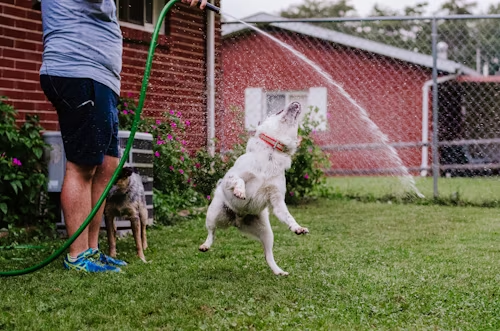
Your dog might know “sit” or “heel” in the living room — but what happens when a squirrel darts across the sidewalk? Or another dog barks from across the street?
If your dog loses focus, pulls on the leash, or ignores your cues in those moments, you’re not dealing with a disobedient dog — you’re dealing with a distracted one.
Teaching your dog to ignore distractions is one of the most important steps in building real-world reliability. In this post, we’ll walk through why distractions challenge your dog’s focus and how to systematically train them to tune in to you instead of everything else.
Why Distractions Are So Powerful
Distractions are anything in your dog’s environment that compete for their attention — sights, sounds, smells, animals, people, or even new locations.
Most dogs aren’t born with the ability to block those things out. Without proper exposure and training, distractions trigger excitement, anxiety, or overstimulation.
The key is not avoiding distractions. It’s training through them in a controlled, consistent way.
How to Start Training Around Distractions
1. Start With Low-Level Distractions
Begin in a quiet space like your backyard or driveway. Practice known commands — sit, down, heel, place — with mild distractions in the background (distant sounds, a family member walking by, a toy nearby).
Reward your dog for choosing to focus on you instead of the environment.
2. Use Distance to Control Intensity
Distance is your best tool when introducing distractions. If your dog reacts to other dogs, start far away and close the gap slowly over multiple sessions.
Stay at a distance where your dog notices the distraction but can still engage with you. That’s the sweet spot for learning.
3. Use Engagement Games to Build Focus
Play games like “name recognition,” “look at me,” or “touch” to reinforce attention. These games build muscle memory around checking in with you — even when distractions are present.
Mark and reward every time your dog makes the right choice to focus.
How to Correctly Respond to a Distraction Reaction
If your dog reacts (pulls, barks, freezes), don’t panic. Stay calm, use leash pressure or body positioning to reset the behavior, and guide them back into focus.
Avoid emotional corrections or overreacting. You want your dog to learn that staying engaged is easier and more rewarding than reacting to every stimulus.
Teach “Look” and “Leave It” as Default Tools
These two commands are essential for managing distractions:
-
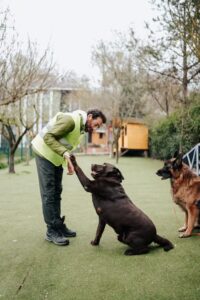
“Look” teaches your dog to break attention from the environment and make eye contact with you
-
“Leave it” teaches your dog to disengage from something tempting and trust your direction
Practice both with mild distractions before applying them in high-distraction areas.
Practice Obedience With Increasing Pressure
As your dog succeeds with low-level distractions, gradually add more challenges:
-
Practice at pet-friendly stores
-
Train near walking trails or sidewalks
-
Work during busier times of day
-
Use food, toys, or noise as controlled distractions
Each level of success builds a more stable, distraction-resistant dog.
What to Avoid
-
Don’t practice obedience only at home
-
Don’t flood your dog with too much too soon
-
Don’t rely only on treats — use praise, space, and release as well
-
Don’t let distractions become an excuse to stop training
Final Thoughts: Reliability Comes From Repetition Under Pressure
The difference between a trained dog and a reliable one is distraction-proofing. By teaching your dog how to stay calm, neutral, and focused in stimulating environments, you’re preparing them for real-world success.
Distractions will always be there — but when your dog learns to ignore them and stay connected to you, that’s when training truly becomes freedom.
Unlock your dog’s full potential with Off Leash K9 Training Bakersfield, you can enjoy the freedom, confidence, and peace of mind that comes with having a well-trained dog. We offer private, personalized training that targets your dog’s specific challenges and helps you build a foundation of trust and respect. We don’t believe in “one-size-fits-all”—we tailor every lesson to your dog’s needs and your goals. Let’s work together to create a better life for you and your dog. Call (661) 655-8787 now to learn more.